HOW MUCH PERFORMANCE ARE YOU LEAVING ON THE TABLE BY OVERLOOKING B VITAMINS?
The stress in the early stages of life of ruminants, whether due to weaning, transport, or environmental changes, can silently impair growth and health, affecting productivity and profitability.
 In this context, there is increasing evidence that B vitamins are an underestimated tool for improving the development of young animals.
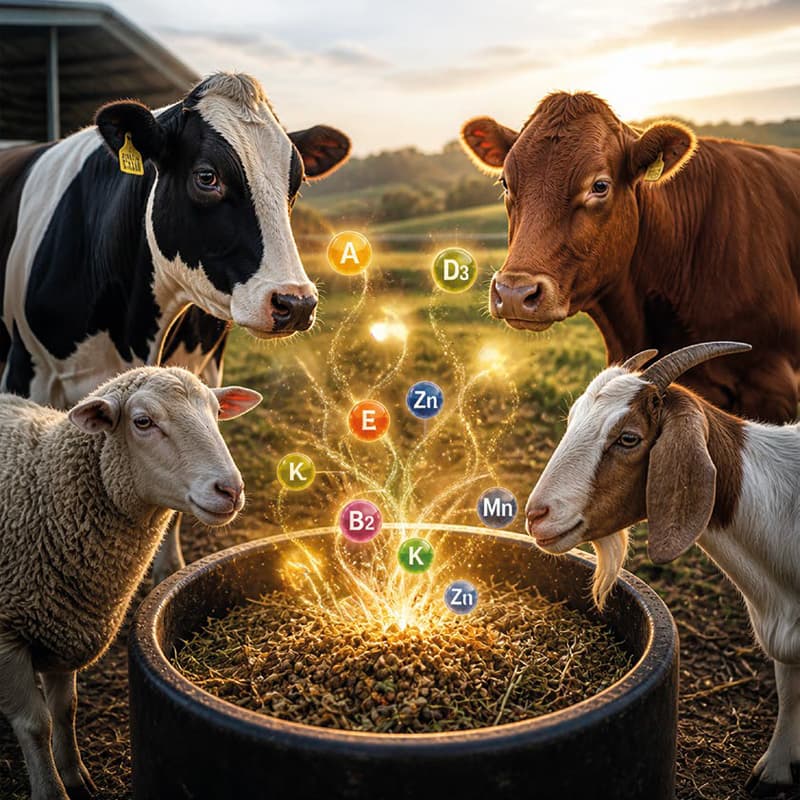
The rumen-protected B vitamins play a key role in supporting metabolism, regulating oxidative stress, and enhancing immunity, exactly when young ruminants are most vulnerable. Ensuring a reliable supply of these vitamins from early stages can translate into better weight gain and overall performance thanks to a more efficient metabolic function. |
HAVE ANIMAL NEEDS EVOLVED ALONG WITH GENETIC IMPROVEMENTS?
The production of ruminants is constantly increasing worldwide, thanks to the genetic improvement of animals and the greater knowledge of professionals in nutrition and food production.
The stress load faced by adult animals during their productive life is well known and, for this reason, the milking group usually receives most of the attention.
 However, young heifers are the future of the herd, and the way they are raised can significantly influence their first gestation, lactation, and productivity.
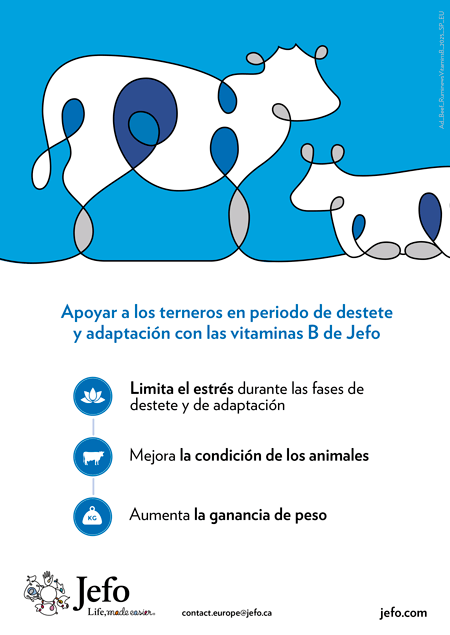
Along with mature animals, calves also face significant stress during the early part of their lives.
 The separation from the mother, weaning, regrouping, and changes in feeding are factors that affect them considerably.
In the best case scenario, these stressors may only result in slower growth, but in the worst case, they can lead to diseases or even death, which places a serious economic strain on the farm. |

ARE YOUNG RUMINANTS MORE VULNERABLE TO OXIDATIVE STRESS?
Recent research has increasingly focused on the fundamental role of oxidative stress in ruminants and their offspring.
Oxidative stress occurs when the formation of reactive oxygen species (ROS) exceeds the organism’s capacity to neutralize free radicals (Sies et al., 1992; Jacob, 1995).
|
The antioxidant defense system of young calves is underdeveloped, making them more vulnerable to the harmful effects of oxidative stress (Inanami et al., 1999).
 During acute episodes of oxidative stress (e.g., transport or regrouping), the concentration of ascorbic acid (vitamin C) in the blood serum of calves decreases significantly, as the body uses it to neutralize reactive free radicals (Mason et al., 1984).
McBride et al. (2001) also observed a significant reduction in plasma vitamin C levels in calves subjected to transport-induced stress.
Various stress factors, such as changes in diet, weaning, grouping, transport, etc., induce oxidative stress, which reduces the antioxidant capacity of the calves and increases lipid peroxidation in their bodies.
This can reduce growth performance and increase susceptibility to diseases caused by both infectious and non-infectious agents.
|
HOW DO B VITAMINS PROMOTE THE HEALTH AND RESILIENCE OF RUMINANTS UNDER STRESS?
The B vitamins function as coenzymes in various metabolic pathways, facilitating the synthesis of essential molecules for body building, including those derived from amino acids, fats, and volatile fatty acids.
 They play a fundamental role in ensuring that individual nutrients are available for the maintenance or development of bones, muscles, and other tissues.
They are particularly important during different stress situations and optimize nutrient utilization during dietary changes (Leclerc et al., 2015).
 Research shows that the demand for pantothenic acid (B5), pyridoxine (B6), folic acid (B9), and vitamin C increases in stressful situations.
According to Mueller and Thomas (1975), the body’s need for pyridoxine and folic acid increases 8 to 15 times, while the need for pantothenic acid and vitamin B12 increases 2 to 4 times in cases of stress or minor injuries.
Some vitamins (folic acid, pyridoxine, riboflavin (B2), vitamin B12) are necessary for the effective functioning of the immune system (Calder et al., 2002; Wintergerst et al., 2006).
Thiamine, riboflavin, and pyridoxine act as cofactors in many metabolic reactions that produce energy and are therefore significantly depleted under stress conditions (Manore, 2000).
|
Other studies have also shown that stress factors, such as transportation and grouping, reduce ruminal activity in calves, even in animals with fully developed rumens, leading to a lower supply of vitamins due to reduced microbial activity (Cole et al., 1979; Gaylean et al., 1999).
|
According to Dubeski et al. (1996), a mild infection reduces the levels of pyridoxine, vitamin B12, and pantothenic acid in the blood of animals.
Restricted access to feed or stress caused by changes in feeding reduce blood levels of pyridoxine and pantothenic acid. Additionally, prolonged transport (>1000 km) also significantly reduces the concentration of pyridoxine in the blood.
Lipid peroxidation caused by oxidative stress significantly reduces the amount of riboflavin in tissues, suggesting that riboflavin plays an important role in defense against lipid peroxidation (Ashoori and Saedisomeolia, 2014).
Taniguchi and Hara (1982) and others have demonstrated that the level of glutathione in the liver decreases significantly in rats when riboflavin supply is low, indicating that the body’s antioxidant defense system is weaker when riboflavin supply is inadequate.
The reduction of riboflavin initially increases the activity of glutathione peroxidase (GPx) as defense against oxidative processes begins, but in the absence of supplements, it leads to a decrease in the activity of antioxidant enzymes (e.g., GPx; Brady et al., 1979).
Supplementation with riboflavin reduces the formation of malondialdehyde (MDA) caused by oxidative stress and increases the activity of other antioxidant enzymes such as superoxide dismutase (SOD) (Wang et al., 2011). |

CAN PROTECTED B VITAMINS IMPROVE PERFORMANCE WHERE IT MATTERS: ON THE FARM?
The characteristics of beef cattle finishing cause significant stress to young calves (weaning, transport, grouping, feed changes, etc.). Therefore, farmers must take measures to help animals overcome these critical periods with minimal stress.
Transport is a major stress factor for young animals that generally results in a weight loss (shrinkage), as the appetite of the animals decreases significantly and remains low in the new location (feedlot) due to social stress caused by grouping. |
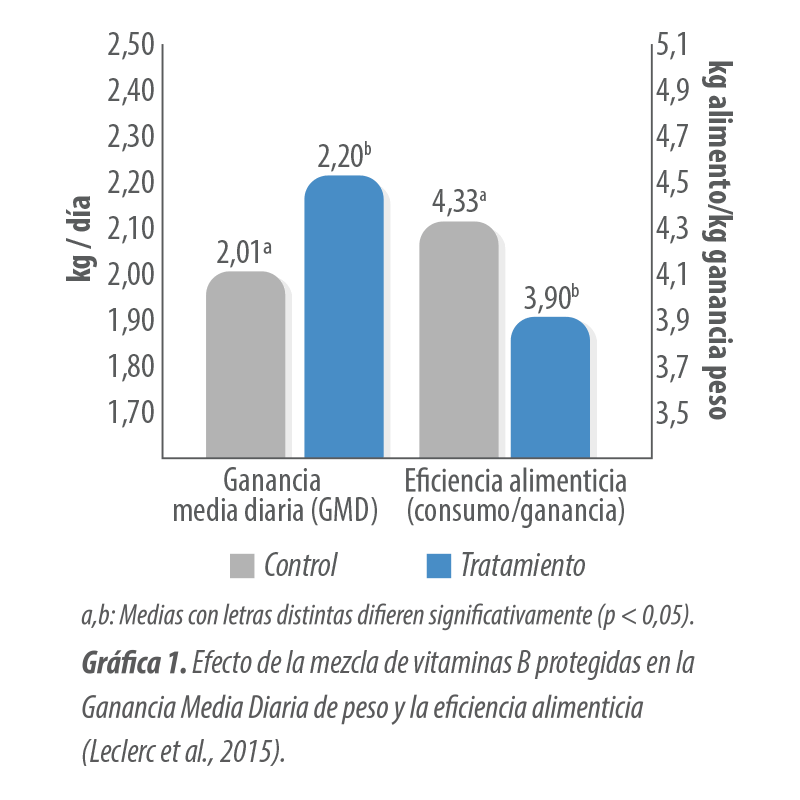
Leclerc et al. (2015) observed that supplementation with protected B vitamins (pantothenic acid, pyridoxine, biotin (B7), and folic acid) for 21 days after arrival reduces the time needed to regain lost weight and increases the average daily gain of the animals (2.20 kg versus 2.01 kg).
Supplementation improved total weight gain and feed efficiency (Graph 1).
 In larger dairy farms, weaning usually occurs around 2–3 months of age, at which point the administration of milk or milk replacer is stopped.
 Calves obtain B vitamins through maternal milk or milk replacer. However, in the period close to weaning, the supply of B vitamins decreases because the rumen, still immature, is not capable of producing them in sufficient quantity.
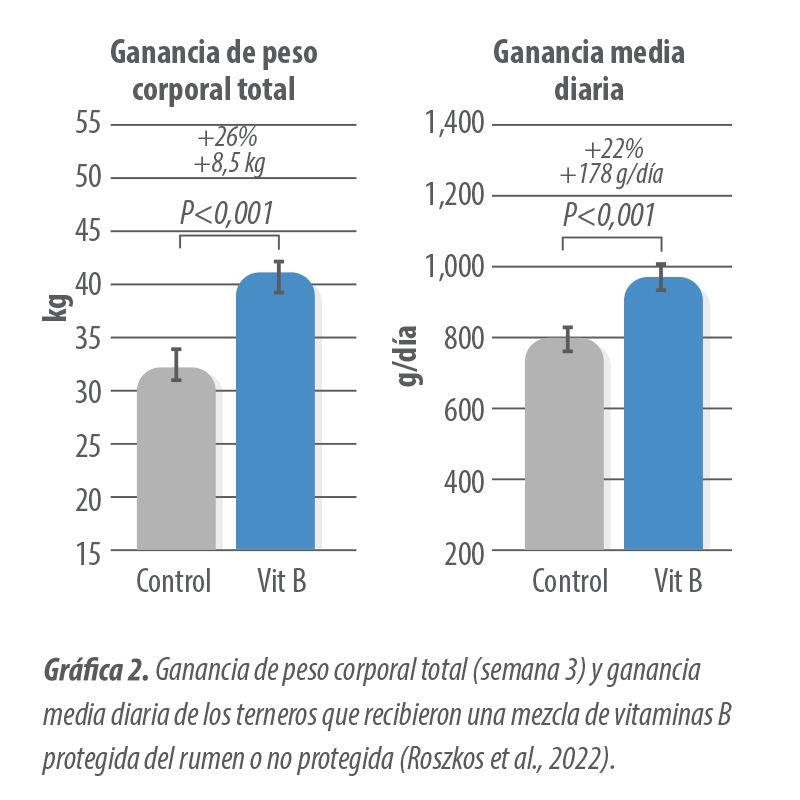
Roszkos et al. (2022) evaluated the effect of a supplementation with a rumen-protected B vitamins mix (thiamine, pantothenic acid, pyridoxine, biotin, folic acid) on the performance of dairy calves during the weaning period compared to a negative control. The animals in the test group received supplements for 42 days (3 weeks before and after weaning).
At the end of the trial, they achieved an average daily gain of 178 g more than the control group, which translated into 8.5 kg additional total weight gain (Graph 2).
These results demonstrate that supplementation with B vitamins can substantially improve the growth of dairy heifers after weaning. |
Consequently, although the developing rumen of conventionally weaned dairy calves is insufficient for endogenous production of B vitamins during this stressful period, it is advanced enough to degrade ingested B vitamins without protection.
Therefore, vitamin supplements should be provided in a rumen-protected form even at this early age.
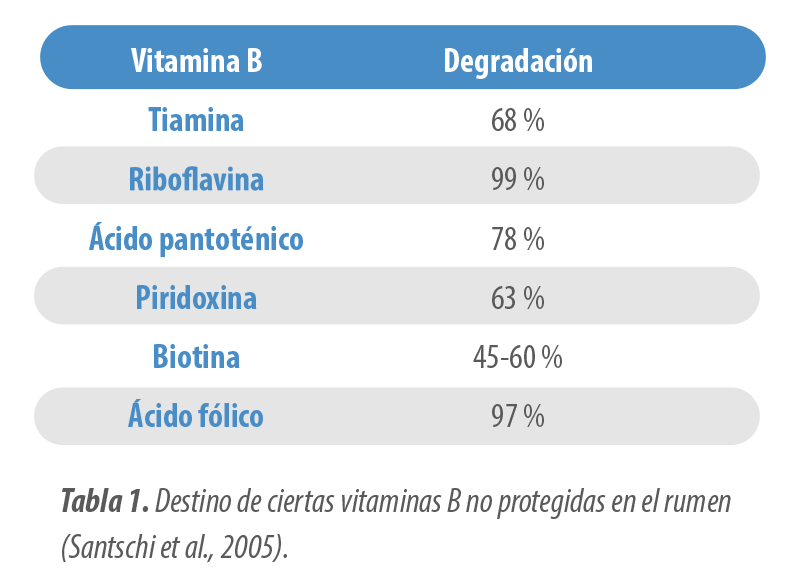
Table 1 illustrates the degradation levels of various B vitamins in the fully developed rumen of a dairy cow, indicating that most B vitamins supplied in unprotected form are lost during fermentation.
During the first months of life, as well as during critical phases of their lives, young ruminants are not able to synthesize the necessary amounts of B vitamins on their own.
In an especially vulnerable time, marked by stress, dietary changes, and immune development, the supply of rumen-protected B vitamins presents itself as an effective tool to promote resilience, growth, and performance.
Caring for this nutritional aspect from the start can be key to ensuring healthier and more productive animals in the future. |