
 However, recent studies have shown that this axis is key to metabolic, immunological, and digestive regulation.
 Recent trials have allowed for the first-time measurement of intestinal permeability in dairy cows, providing key information on the relationship between inflammation and productivity.
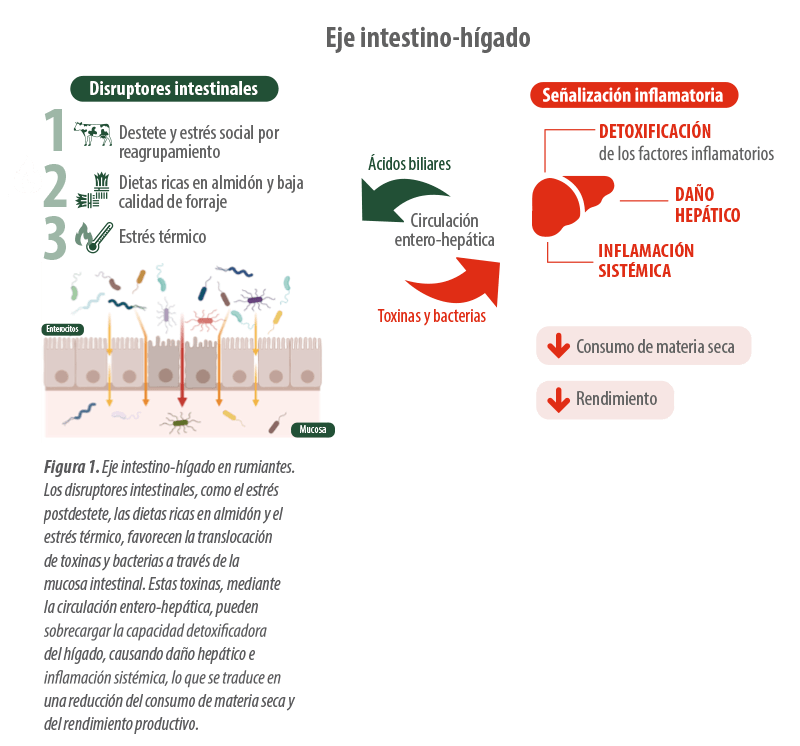
 This allows the passage of endotoxins and microbial products into the systemic circulation, generating an immune activation and a higher energy consumption for the inflammatory response, which negatively affects milk production and animal welfare.
 However, alterations in the microbiota, caused by inadequate diets, diseases, or environmental changes, can favor the proliferation of pathogenic bacteria and the production of toxic metabolites that affect liver health.
 Starch-rich diets and low-quality forage:
 Supplementation with
  Citric acid optimizes energy production in the Krebs cycle and reduces oxidative stress, while sorbic acid has antimicrobial properties that affect the viability of gram-negative bacteria, contributing to better digestive health.


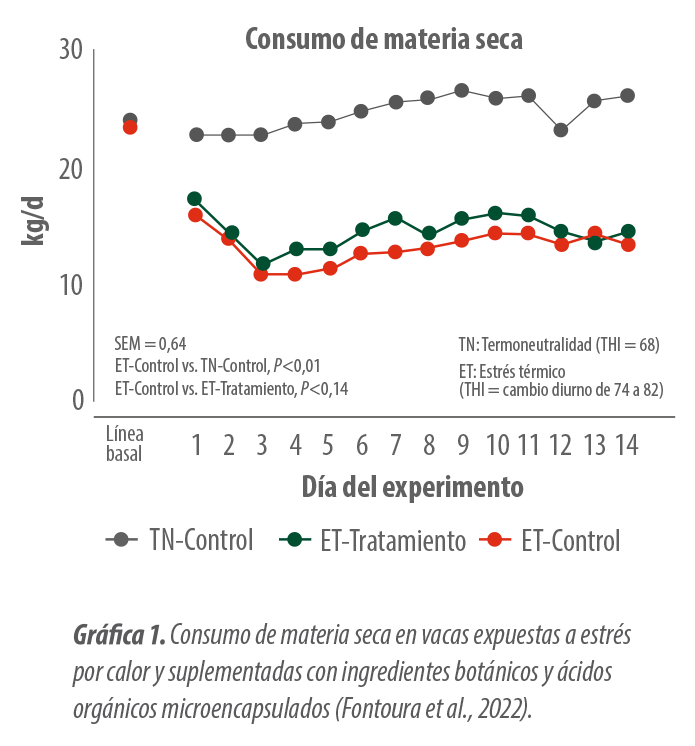
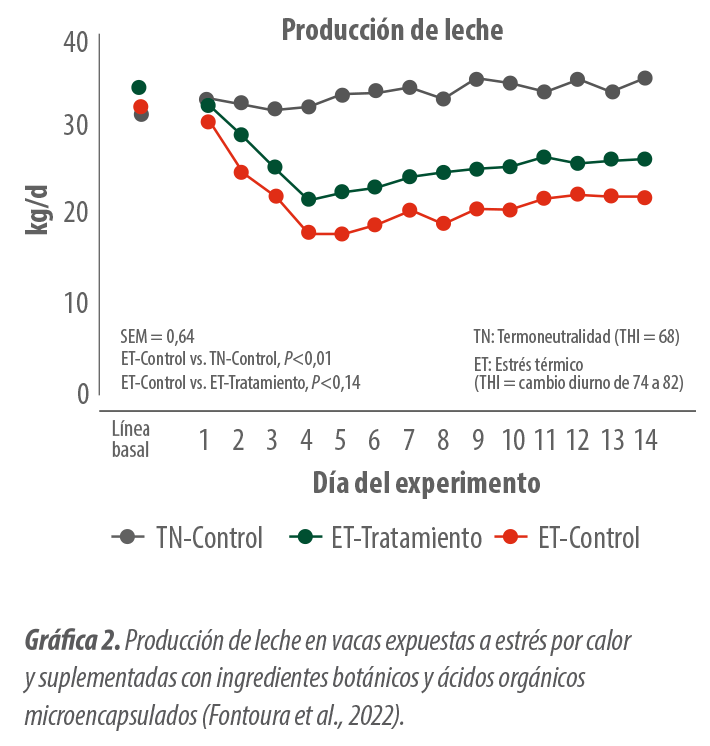
 In fresh cows, a decrease in rectal temperature (0.5 °C) and a significant increase in milk yield (+2.4 kg/d) were recorded, along with an improvement in milk protein (Sáinz de la Maza- Escolà et al., 2022).
|
The intestine-liver axis is a key system in the health and productivity of dairy ruminants. Maintaining its integrity is essential to optimize productive efficiency and minimize the consequences of stress and environmental challenges.
|
 The use of botanical ingredients and microencapsulated organic acids represents a promising strategy to improve intestinal and liver health, reducing inflammation and promoting animal welfare and performance.
BIBLIOGRAPHY
EFSA. 2012. Scientific Opinion on the safety and efficacy of AviPlus® as feed additive for chickens and minor avian species for fattening and reared for laying and minor porcine species (weaned). EFSA J. 10:2670–2681.
Fontoura, A., A. Javaid, V. Sáinz De La Maza-Escolà, N. Salandy, S. Fubini, E. Grilli, and J. W. McFadden. 2022. Heat stress
develops with increased total tract gut permeability, and dietary organic acid and pure botanical supplementation partly
restores lactation performance in Holstein dairy cows. J. Dairy Sci. 105:7842-7860.
Fontoura, A., V. Sáinz De La Maza-Escolà, R. Andrew, B. Tate, M. Van Amburgh, E. Grilli, and J. W. McFadden. 2023. Effects of dietary organic acid and pure botanical supplementation on growth performance and circulating measures of metabolic health in Holstein calves challenged by heat stress. J. Dairy Sci. 106:2904-2918
Giorgino, A., F. Raspa, E. Valle, D. Bergero, D. Cavallini, M. Gariglio, V. Bongiorno, G. Bussone, S. Bergagna, F. Cimino, L.
Dellepiane, G. Mancin, R. Paratte, V. Sáinz de la Maza-Escolà, and C. Forte. 2023. Effect of Dietary Organic Acids and Botanicals on Metabolic Status and Milk Parameters in Mid–Late Lactating Goats. Animals. 13-5:797
Lobo, R., L. F. Wurdig-Roesch, E. Grilli, and A. Faciola. 2023a. Effects of microencapsulated blend of organic acids and pure
botanicals on the ruminal microbiota in an in vitro dual-flow continuous culture system. Fermentation. 9(8):730.
Lobo, R., M. Watson, J. R. Vinyard, M. L. Johnson, A. Bahman, S. W. Ma, G. Dagaew, P. Sumadong, E. Sarmikasoglou, E. Grilli, J. A. Arce-Cordero, and A. Faciola. 2023b. In vitro evaluation of microencapsulated organic acids and pure botanicals as a supplement in lactating dairy cows diet on in vitro ruminal fermentation. Trans. Anim. Sci. 7:1-10.
Rossi, B, Toschi, A, Piva, A, and Grilli, E. Single Components of Botanicals and NatureIdentical Compounds as a Non-Antibiotic Strategy to Ameliorate Health Status and Improve Performance in Poultry and Pigs. Nutr. Res. Rev. 2020, 33, 218–234.
Sáinz de la Maza-Escolà, V., R. Paratte, A. Piva, and E. Grilli. Organic acids and botanicals supplementation on lactation performance in heat-stressed dairy cows. 2022. EAAP Annual Meeting. (28) 566:22.
Sáinz de la Maza-Escolà, V., G. Li, F. Ghiseli, X. V. Yu, A. Fontoura, A. Javaid, N. S. Salandy, S. L. Fubini, E. Duan, E. Grilli, and J. W. McFadden. 2023. Effects of heat stress and dietary organic acid and pure botanical on hepatic transcriptome. 2023 J. Dairy Sci. Vol. 106, Suppl. 1:2285.
Thomas, M., J. Moncada Torres, V. Sáinz de la Maza-Escolà, A. Piva, E. Grilli, P. Lira, J. Venegas Flores, M. Stangaferro. 2025. Effect of feeding microencapsulated botanicals and organic acids to lactating Holstein cows under heat stress conditions on milk production performance and feed efficiency—A pen-level randomized controlled trial. 2025. J. Dairy Sci. ADSA.
Continue reading this content
Register for free or log in to access all rumiNews content.