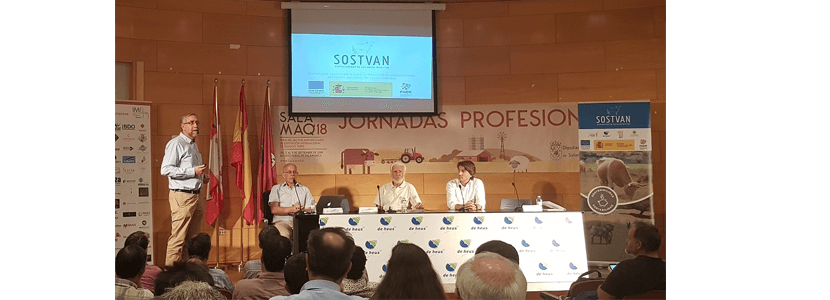
Within the framework of Salamaq 18, the Salamanca Agricultural Fair, held between September 5 and 9, the SOSTVAN Project Operational Group was presented, an initiative that aims to advance towards sustainable livestock farming and its beneficial effects on the dehesa, one of the most environmentally unique ecosystems in our country.
De Heus Animal Nutrition and the institutions participating in the SOSTVAN Project are committed to defending and promoting the production of suckler cows and calves in extensive systems, as it is a model that provides profitability to the farmer and ecological value to the dehesa.
SOSTVAN is funded by the European Union with FEADER funds and by the Ministry of Agriculture and Fisheries, Food and Environment, led by De Heus Animal Nutrition along with UGAVAN (Union of Suckler Cow Farmers) and the Universities of Salamanca and Extremadura. It also has the collaboration of ITACYL, the slaughterhouses El Encinar de Humienta and Dehesa Grande, Zoetis, the 19th of April Farmers Association and the technical support of Imasde Agroalimentaria.
During the official presentation event, the introduction was given by the President of the Salamanca Provincial Council, Francisco Javier Iglesias García, and it was attended by Jesús Carrizo Martín, Director of Nutrition and Formulation at De Heus, Antonio Gamonal Adámez, President of the Union of Suckler Cow Farmers (UGAVAN), Fernando Vicente Amores, from the Department of Business Administration and Economics at the University of Salamanca, and Gerardo Moreno Marcos, from the Department of Plant Biology, Ecology and Earth Sciences at the University of Extremadura.
Among the objectives of the SOSTVAN Project is to develop tools to improve the sustainability of calf production in extensive systems, fattening them on the farms themselves, improving their profitability and reducing the environmental impact to produce the highest quality meat. Work will also be done on a platform that, by applying Blockchain technology to livestock production, will provide maximum transparency, information, and security to the final consumer. The implementation of Blockchain throughout the production chain will ensure the traceability of food from the farmer to the consumer.