- The method also helps improve the economic profitability of beef cattle farms in Spain.
- The project, driven by Provacuno, arose from the livestock sector’s need to move towards knowledge-based production systems that improve efficiency and reduce the environmental footprint.

The Interprofessional Organization of Beef (PROVACUNO), the Miguel Hernández University (UMH) and the Polytechnic University of Valencia (UPV) have developed an innovative composting protocol that allows reducing gas emissions and increasing the fertilizing value of beef cattle manure. This new protocol will help improve the environmental and economic sustainability of livestock farms in Spain.
The project, driven by Provacuno, arose from the livestock sector’s need to move towards knowledge-based production systems that improve efficiency and reduce the environmental footprint.
After two and a half years of research, the method developed by the UMH-UPV team and Provacuno allows optimizing the composition of compost piles and their management on farms, thus achieving a notable reduction in gas emissions and a higher concentration of nutrients in the final compost. This result provides a double benefit: on one hand, it reduces environmental impacts and, on the other, it increases the added value of the compost as an agricultural fertilizer.
Two phases
In the first phase, the UPV-UMH research team conducted an exhaustive characterization of manure from different types of beef cattle farms in Spain.
“This allowed the development of a tool to calculate the fertilizer value, which helps farmers with the appropriate dosage of manure in the field, adjusted to agronomic needs,” highlights Salva Calvet, researcher at the Institute of Animal Science and Technology (ICTA) of the Universitat Politècnica de València.
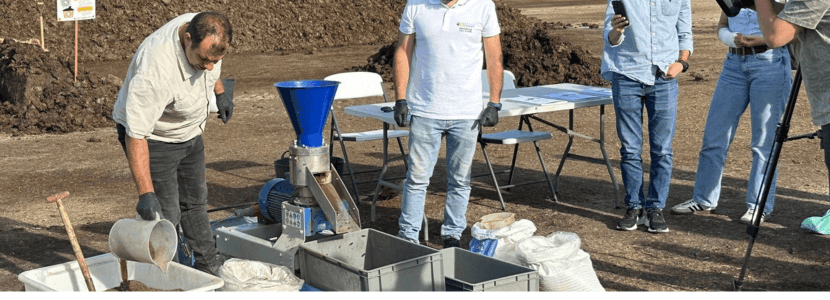
In the second phase, the research team designed and validated the advanced composting protocol, applying monitoring and control systems in the laboratory (UMH-CIAGRO) and in real farms distributed throughout Spain.
“The results obtained have allowed the protocol to be validated as “Best Available Technique” (BAT), thus ensuring its economic viability and its implementation in any type of farm, both newly created and existing farms,” highlights Raúl Moral, from the CIAGRO group of the Universidad Miguel Hernández.
The guide with all the results and recommendations for farmers is available for free on the Provacuno website.
Three leaders in the sector
The multidisciplinary collaboration of the teams from the UPV, the UMH, and Provacuno has been key to the success of the project. The CIAGRO group at UMH, a leader in waste valorization and nutrient flows, has led the development of advanced composting technologies; meanwhile, the UPV-ICTA group, with extensive international experience in emission measurement and mitigation, has contributed to ensuring that the results are applicable on the farm and accepted by the Administrations.
Following this project, the team is working on developing tools to determine the composition of manure in real-time —without the need for laboratory chemical analysis— and on designing new biofertilizers from the generated compost.
“These actions will allow progress in emission reduction and decrease dependence on imported fertilizers,” concludes Javier López, director of Provacuno.
About PROVACUNO
PROVACUNO is the Interprofessional Organization of Beef, a private, non-profit entity with a national scope, integrated by the main organizations of the production sector and the processing/marketing sector for the defense of the interests of the beef sector, a meeting place and forum for debate to improve the situation of the sectoral food chain.
More information here
If you want to know about other studies by Provacuno click here
Continue reading this content
Register for free or log in to access all rumiNews content.