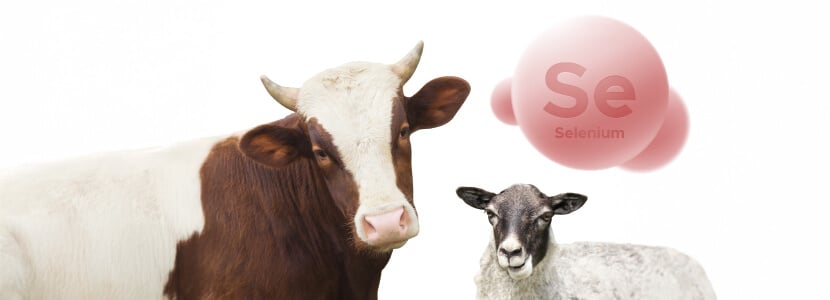
Trace minerals such as selenium (Se) are added in very small amounts to livestock diets, as they are essential to support the potential, productivity, and welfare of the animals.
In nature, Se exists in two chemical forms:
 Inorganic Se: can be found as selenite, selenate, and selenide.
 Organic Se: is mainly found as selenomethionine (SeMet) in forages, grains, and oilseed meals.
Animals receive Se mainly in the form of SeMet and, therefore, are better adapted to utilize Se in this natural or organic form.
Plants absorb Se from the soil in the form of selenite or selenate, then synthesize selenium-containing amino acids, including SeMet, which accounts for approximately 50% of the Se in cereal grains.
 The concentration of Se in the soil varies significantly, affecting its availability to plants.
IMPORTANCE OF SELENIUM FOR RUMINANT HEALTH
|
The Se is an essential trace mineral for animal nutrition, primarily due to its key role in:
|
 Oxidative stress is recognized as a factor that negatively influences immune function and improving immunity during periods of stress can reduce excessive proliferation of secondary pathogens and infections.
 In this regard, Se is a crucial antioxidant that, along with vitamin E, has a significant impact on oxidative stress. Thus, adequate Se supplementation can improve the efficiency of leukocytes and antioxidants such as glutathione peroxidase.
During demanding stages of life (rapid growth, late gestation, or lactation), Se requirements increase in animals and, when lacking, the effects range from mild to severe, including:
 White muscle disease in lambs, calves, and goat kids.
Reduced fertility and embryonic death.
Retention of fetal membranes, metritis, poor uterine involution, and cystic ovaries in cows.
Subclinical mastitis and impaired immune function.
Prematurity, perinatal death, and abortion.
Often, subclinical deficiency goes unnoticed, silently undermining productivity and welfare.
For example, the milk neutrophils of cows fed a Se-deficient diet have a significantly reduced ability to kill ingested Escherichia coli and S. aureus, compared to the cells of cows fed a Se-supplemented diet.
The supplementation with Se in dairy cattle helps protect oocytes from oxidative damage and supports follicular growth, helping to regulate the hormones necessary for ovulation, leading to better fertility, fewer abortions, and healthier calves. |
WHAT TYPE OF SELENIUM PROVIDES BETTER RESULTS IN RUMINANTS?
Since most feed ingredients worldwide are Se-deficient, dietary supplementation with Se is a standard commercial practice.
Se supplementation is associated with improvement in animal health, observing:
 Reduction in the prevalence of retained fetal membranes.
Decrease in the severity and prevalence of clinical mastitis.
Reduction in somatic cell count in milk.
Decrease in calf mortality.
The tentative critical levels of Se are as follows:
 Forage and grains: a content of 0.1 mg/kg of dry matter is considered adequate.
 Soil: soils containing less than 0.5 mg/kg will likely produce crops with inadequate Se concentrations.
 Animal tissues, blood, and milk: the concentration of Se in various tissues is a reliable indicator of the animal’s Se status.
There is a positive correlation between the Se content of the feed and the Se content in the tissues and blood of the animals that ingest it, and the values fluctuate with the dietary intake of the element.
|
INORGANIC Se The main Se supplements used over the last 50 years have been selenite and selenate (mainly sodium selenite), both inorganic forms of Se. These inorganic forms have limitations such as: |
|
ORGANIC Se Organic Se, such as SeMet, is better absorbed and retained in the body compared to inorganic Se.
However, there can also be substantial differences in toxicity, stability, and efficacy among organic Se products. |
Availability of Se in ruminants
The absorption of Se tends to be much lower in ruminants compared to non-ruminants, with the small intestine being the main site of absorption. In this regard, it should be noted that the intestinal availability of Se depends on its origin (inorganic or organic) due to the effect of the ruminal environment (Figure 1):
 The ability of ruminants to utilize inorganic Se is strongly influenced by the highly reducing environment of the rumen. In fact, the rumen reduces selenate to selenite, which in turn is converted into insoluble low molecular weight forms (elemental Se), probably non-absorbable, which are then excreted in the feces, thus reducing the intestinal availability of Se.
 When organic forms (SeMet) are supplemented, the Se seems to undergo fewer alterations in the ruminal environment.
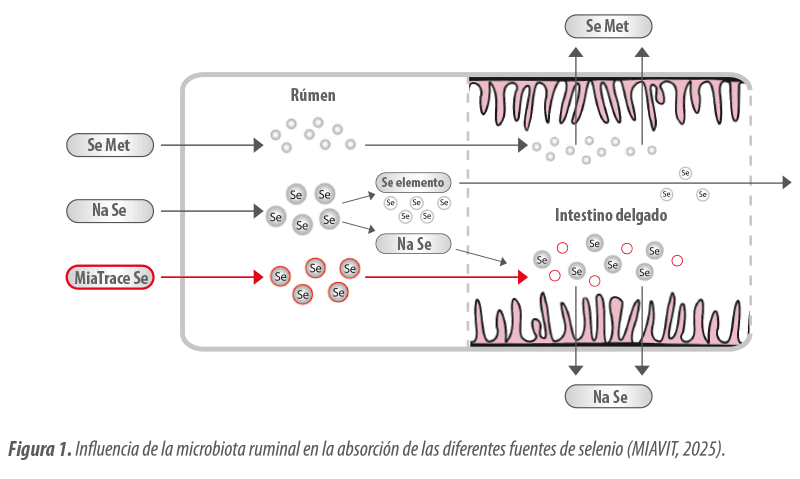
The absorption of inorganic Se can be as low as 13% in steers and between 10-16% in dry and lactating cows. Weiss (2005) reports that the absorption coefficient of inorganic Se in dairy cows is estimated at 50%, while organic Se, derived from forages or grains where it is incorporated as SeMet, is estimated at 65%. |
RUMEN-PROTECTED SELENIUM: GREATER BIOAVAILABILITY AND EFFICIENCY IN USE
In recent years, rumen-protected Se sources have gained prominence in the market.
MiaTrace Se from Miavit GmbH is a coated sodium selenite that provides specific rumen protection to ensure and improve the Se status in ruminants.
The Se particles reach the target absorption site without alterations thanks to the reliable protective capsule.
Intestinal enzymes quickly dissolve the capsule to ensure a high absorption rate.
It can be used in complete feeds and replace up to 50% of the total Se content.
|
MiaTrace Se offers a higher selenium bioavailability compared to inorganic Se sources and its efficacy is comparable to that of organic Se sources.
References available upon request. |
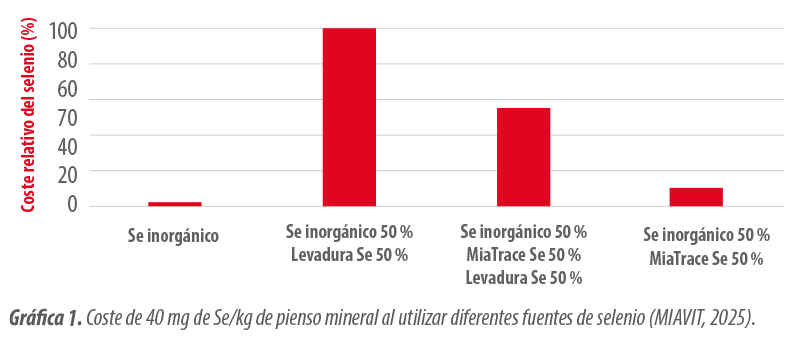
 When included in mineral feeds or vitamin-mineral premixes (Graph 1), it reduces the cost of Se and allows maintaining the same efficacy offered by organic sources.