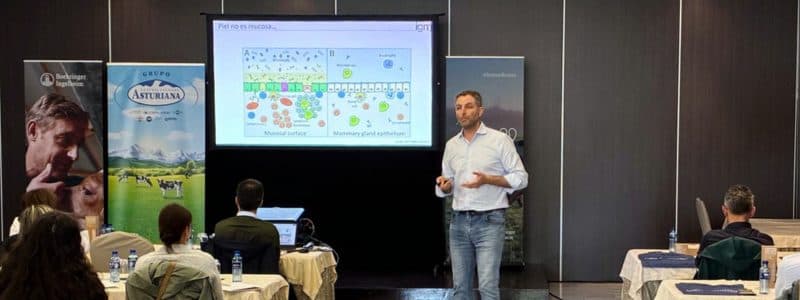

On this occasion, the session took place in Vic on June 28, with the collaboration of Grupo Gepork.
Mario Clemente, Ruminants veterinary technician at Zoetis in the regions of Aragón, Catalonia, and Navarra, was responsible for conveying to the attendees the issue of BRD in our country and the importance of a good vaccination program according to the prevalence of the main pathogens involved in this syndrome.
Specifically, referring to calf fattening, the sector that focused the talk, the study concludes that the four main viruses involved in BRD (Infectious Bovine Rhinotracheitis (IBR), Bovine Viral Diarrhea (BVD), Bovine Respiratory Syncytial Virus (RSV), and Parainfluenza 3 Virus (Pi3)) are present throughout the Spanish geography, “with a very high farm seroprevalence, over 90% (Pi3)”, Clemente emphasized.
Regarding bacteria, the study shows that M.bovis is the main one involved in BRD outbreaks, as “it is present in 100% of farms and has a very high total individual prevalence.”
After presenting the results and main conclusions of the field study, Clemente stressed that “it is essential to consider all the pathogens involved in BRD, and to protect and prevent the cattle comprehensively against those that most frequently appear on farms.” Only in this way will it be possible to maintain the health status of the farm and, therefore, its profitability.
About Zoetis
Zoetis is the leading animal health company, dedicated to supporting its customers and their businesses. Built on 60 years of animal health experience, Zoetis discovers, develops, manufactures, and markets veterinary medicines and vaccines complemented by diagnostic products and supported by a wide range of services.
In 2017, the company generated annual revenues of more than USD 5.307 billion. With nearly 9,000 employees globally, its products serve veterinarians, farmers, producers, and all those who raise and care for livestock and companion animals in more than 100 countries.
More information at www.zoetis.es