



The eradication of tuberculosis (TB) represents a significant challenge for animal health and public health worldwide, with goats being one of the main reservoirs of zoonotic TB (TBz) —the infection in humans with an animal origin— which is especially prevalent in middle and low-income countries (Macedo Couto et al., 2019).
 Even in countries like Spain, cases of TBz transmission from goats have been described in recent years (Martínez-Lirola et al., 2023; Pérez De Val et al., 2025).
In addition to the risk that TB poses to public health, its presence in goats also entails significant implications for animal health and welfare and other economic implications.
|
 In Spain, there is no national TB eradication program for goats and the control and surveillance of this infection in goats is only mandatory in those herds that maintain an epidemiological relationship with cattle or in the case of intra-community movement.
However, many autonomous communities have implemented mandatory or voluntary regional TB eradication programs (Bezos et al., 2014; MAPA, 2024).
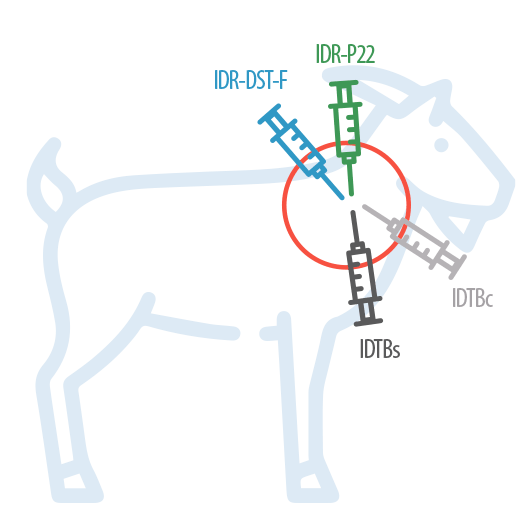
These programs are fundamentally based on a strategy of diagnosis and culling of goats positive to official diagnostic techniques (cell-based immunological tests):
|
 |
These techniques present limitations in terms of their sensitivity and specificity in certain epidemiological contexts due, among other factors, to the composition and quality of the tuberculins or purified protein derivatives (PPDs) used as reagents (Good & Duignan, 2011; Schiller et al., 2010). |
 Mainly,
  In certain circumstances,
INTERNATIONAL PROJECT imdiTBap: IN SEARCH OF NEW TB DIAGNOSTIC TOOLS
Some of the antigens of bovine PPD (PPDb) are present in environmental mycobacteria not causing TB, such as Mycobacterium avium subsp. paratuberculosis, the causative agent of paratuberculosis (PTB), and whose infection or vaccination can lead to the appearance of interferences in TB diagnosis (Fernández-Veiga et al., 2023; InfantesLorenzo et al., 2017).
It is essential to develop and evaluate new immunogenic and specific antigens of mycobacteria causing TB, which can be:
 Synthetic like the fusion protein DST-F (Jones et al., 2022).
 Obtained through immunopurification techniques, such as the protein complex P22 obtained from PPDb (Infantes-Lorenzo et al., 2017).
|
 The project “Improving the diagnosis of tuberculosis in domestic ruminants through the use of new antigens and test platforms” (imdiTBap) aims, among other objectives, to generate large-scale data on the performance of the antigens
 This project, initiated in mid-2023 and lasting three years, involves the participation of renowned research groups from Spain, Ireland, Italy, the United Kingdom, and Turkey.
 VISAVET-UCM is the coordinator and one of the groups responsible for evaluating the performance of DST-F and P22 in IDTB and IGRA in domestic ruminants under field conditions.
To date, around 5,000 skin and blood analyses have been conducted, including analyses from studies on goats.
Design of field studies in goats
Sensitivity of DST-F and P22
|
Specificity of DST-F and P22
|
 For the evaluation of the sensitivity of these reagents, 167 goats from two farms with a history of TB infection confirmed by bacteriology were randomly selected.
 Specificity analyses were conducted on 197 goats from two farms with a history of negativity to official diagnostic tests (IDTBc) within the context of the regional caprine TB eradication program.
All herds included in the study had implemented a vaccination program against PTB and in all of them, the presence of PTB was confirmed from environmental samples taken with wet sponges (Genetic PCR Solutions, Orihuela, Spain) on different surfaces of the farm.
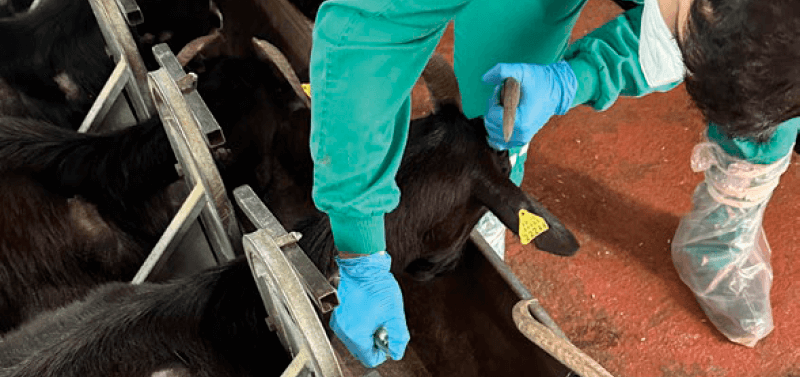
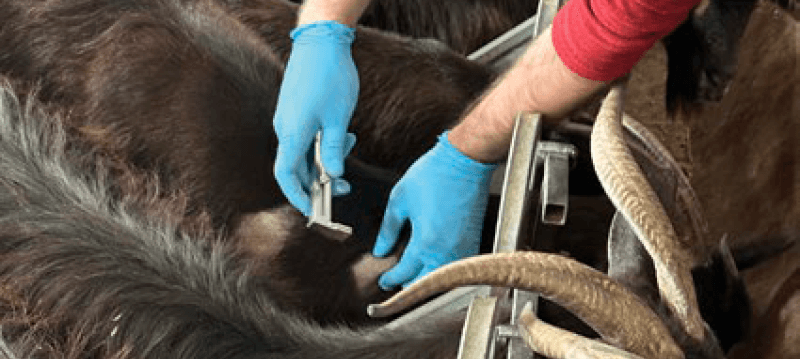
The animals were subjected to the IDTBs, IDTBc test and an intradermal reaction (IDR) with DST-F (IDRDST-F) and P22 (IDR-P22).
Additionally, blood samples were taken for subsequent stimulation with traditional PPDs, DST-F and P22 and to perform the IGRA technique with two commercial kits: Bovigam (ThermoFisher Scientific, Waltham, USA) and ID Screen Ruminant IFN-g (Innovative Diagnostics, Grabels, France).
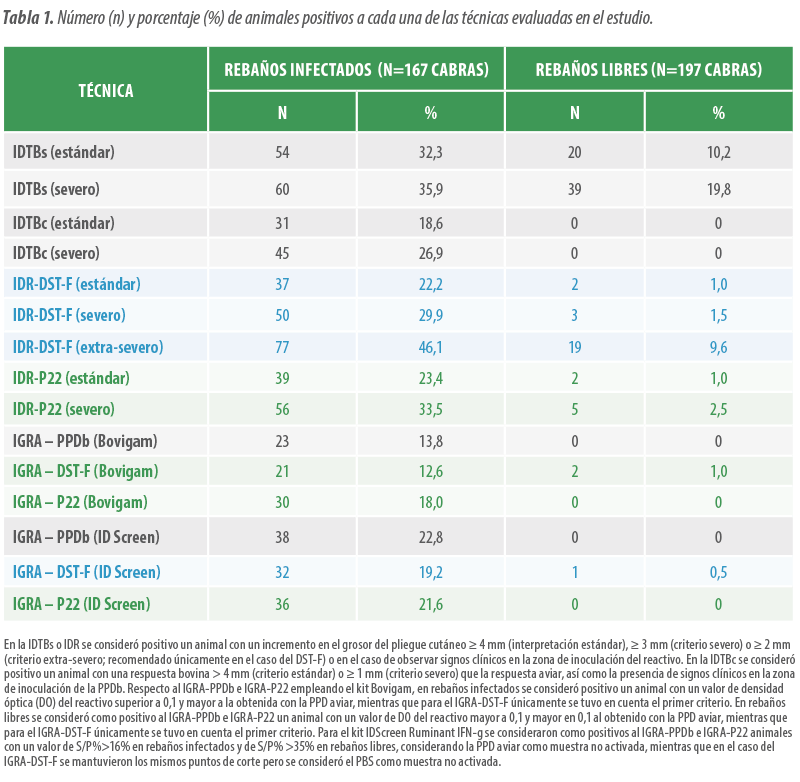
The interpretation criteria for the different intradermal tests (IDTBs, IDTBc, and IDR) and the IGRA technique using the two diagnostic kits are described in Table 1.
|
 The differences in the number of reactors to the different techniques of the study were analyzed using Cochran’s Q test and a p-value of 0.05 was considered statistically significant.
Main results and discussion 
RESULTS OF THE INTRADERMAL TESTS
Sensitivity of PPDs, DST-F, and P22
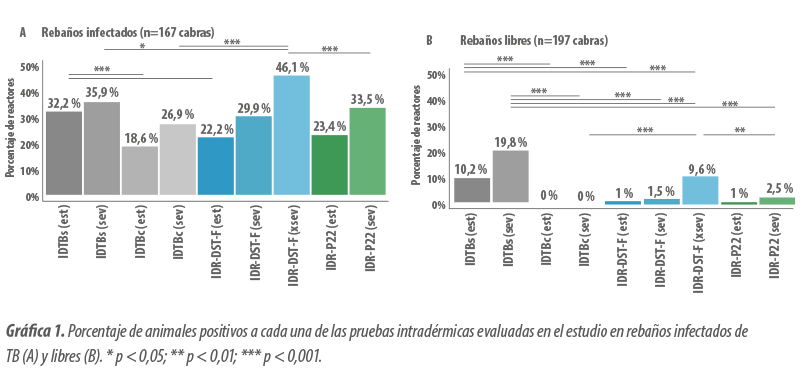
In the intradermal tests in infected herds, a higher percentage of reactors to the IDTBs was observed compared to the rest of the techniques when applying a standard criterion (32.3%) (with significant differences in some comparisons; Table 1 and Figure 1A) and severe (35.9%).
 The highest percentage of positive animals in the intradermal test was observed when applying an extra-severe criterion recommended for the DST-F (46.1%) in infected herds, which was significantly higher compared to the rest of the techniques (Figure 1A), although it was related to a significant decrease in specificity in free herds (Figure 1B)
Specificity of PPDs, DST-F and P22
In the non-infected herds, a significantly lower percentage of positives in the IDR-DST-F (1.0% and 1.5%), IDR-P22 (1.0% and 2.5%) and IDTBc (0.0% for both cases) was observed compared to IDTBs (10.1% and 19.7%; p < 0.001) when applying standard and severe criteria respectively, thus demonstrating a greater specificity of these techniques (Table 1 and Figure 1B).
 However, an impact of PTB vaccination cannot be ruled out, especially on the specificity results of IDTBs in TB-free herds (Roy et al., 2018; Middleton et al., 2021).
IGRA RESULTS
Sensitivity of PPDb, DST-F and P22
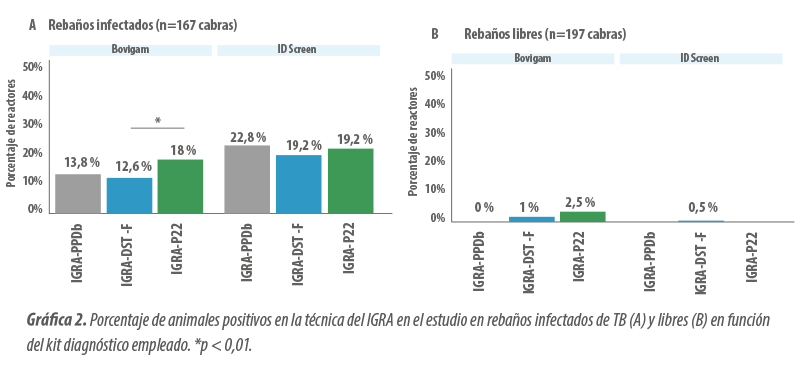
Regarding the IGRA results in the TB infected herds, when using the Bovigam kit the percentage of positive goats was higher when samples stimulated with P22 were analyzed (18.0%) compared to PPDb (13.8%; p > 0.05) and significantly higher with respect to DST-F (12.6%; p < 0.05) (Table 1 and Figure 2A).
Specificity of PPDb DST-F and P22
When the ID Screen kit was used in the infected herds, no significant differences (p > 0.05) were observed in the percentage of positives when stimulated with PPDb (22.8%), DST-F (19.2%) or P22 (21.6%).
Similarly, in the free herds, no significant differences were observed in the percentage of reactors when analyzing samples stimulated with PPDb, DST-F or P22, regardless of the kit used (Table 1 and Figure 2B).
RESULTS VS TRADITIONAL PPDs
The reactivity observed using PPDb and the rest of the experimental antigens in the in vitro techniques evaluated in this study, both in infected herds and especially in the free ones, was quite similar (or at least more similar than expected), a finding that adds to the variety of results previously published in this regard (Arrieta-Villegas et al., 2020; Middleton et al., 2021).
More in-depth analyses are needed to clarify the possible causes of these results, including the possible effect derived from the biological potency of the PPDb batch used in the field studies (Echevarría et al., 2024; Good et al., 2011) or the one used for obtaining P22 through immunopurification.
In this sense, it is important to note that DST-F is a synthetic product, whose composition is perfectly known and quantifiable, being more complex to determine in the case of PPDs.
This composition is related to the biological activity of the PPDs themselves, which is difficult to accurately evaluate in animal models and can be affected by the production methodology, varying between manufacturers.
CONCLUSIONS
The preliminary results of field studies in goats suggest that the use of antigens DST-F and P22 in the intradermal test could offer a better balance between sensitivity and specificity compared to the use of PPDs, especially with IDTBs and in certain epidemiological contexts.
However, although the extra-severe cutoff point of 2 mm recommended by the developer for IDR-DST-F may improve the sensitivity of IDTBs, it seems to cause a very high loss of specificity in TB-free herds.
Regarding IGRA, the use of P22 improved the sensitivity obtained with PPDb when using the Bovigam kit without a significant detriment in specificity.
The PPDb, DST-F and P22 reagents showed similar performance in terms of sensitivity and specificity when using the ID Screen kit.
However, there are still analyses to be carried out until the end of the project, including those conducted in other countries and in cattle and buffalo, which will allow these findings to be confirmed.
Acknowledgments This research has been made possible thanks to the funding from ICRAD, an ERA-NET network co-funded by the European Union’s Horizon 2020 research and innovation program (https://ec.europa.eu/ programmes/horizon2020/en) under grant agreement nº862605, and the Ministry of Science, Innovation and Universities of Spain (MCIN/AEI/10.13039/501100011033) through the project “Improving the diagnosis of tuberculosis in domestic ruminants through the use of new antigens and test platforms” (reference PCI2023- 143368), and the Ministry of Agriculture, Fisheries and Food of Spain.
You may be interested in: Tuberculosis in goats: epidemiological situation in Spain and advances in its diagnosis
BIBLIOGRAPHY
Arrieta-Villegas, C., Infantes-Lorenzo, J. A., Bezos, J., Grasa, M., Vidal, E., Mercader, I., Singh, M., Domingo, M., de Juan, L., & Pérez de Val, B. (2020). Evaluation of P22 Antigenic Complex for the Immuno-Diagnosis of Tuberculosis in BCG Vaccinated and Unvaccinated Goats. Frontiers in veterinary science, 7, 374. https://doi.org/10.3389/fvets.2020.00374
Bezos, J., Álvarez, J., Romero, B., Aranaz, A., & Juan, L. D. (2012). Tuberculosis in goats: Assessment of current in vivo cell-mediated and antibody-based diagnostic assays. The Veterinary Journal, 191(2), 161-165. https://doi.org/10.1016/j.tvjl.2011.02.010
Bezos, J., Marqués, S., Álvarez, J., Casal, C., Romero, B., Grau, A., Mínguez, O., Domínguez, L., & De Juan, L. (2014). Evaluation of single and comparative intradermal tuberculin tests for tuberculosis eradication in goat herds in Castilla y León (Spain). Research in Veterinary Science, 96(1), 39-46. https://doi.org/10.1016/j.rvsc.2013.10.007
Echeverría, G., Zumárraga, M. J., Proaño-Pérez, F., Blasco, F. B., & de Waard, J. H. (2024). Assessing the impact of various tuberculin PPD brands on bovine tuberculosis diagnosis. Scientific reports, 14(1), 5155. https://doi.org/10.1038/s41598-024-52089-1
Fernández-Veiga, L., Fuertes, M., Geijo, M. V., Pérez De Val, B., Vidal, E., Michelet, L., Boschiroli, M. L., Gómez-Buendía, A., Bezos, J., Jones, G. J., Vordermeier, M., Juste, R. A., Garrido, J. M., & Sevilla, I. A. (2023). Differences in skin test reactions to official and defined antigens in guinea pigs exposed to non-tuberculous and tuberculous bacteria. Scientific Reports, 13(1), 2936. https://doi.org/10.1038/s41598-023-30147-4
Good, M., Clegg, T. A., Costello, E., & More, S. J. (2011). The comparative performance of the single intradermal test and the single intradermal comparative tuberculin test in Irish cattle, using tuberculin PPD combinations of differing potencies. Veterinary journal (London, England: 1997), 190(2), e60–e65. https://doi.org/10.1016/j.tvjl.2011.01.005 Good, M., & Duignan, A. (2011). Perspectives on the History of Bovine TB and the Role of Tuberculin in Bovine TB Eradication. Veterinary Medicine International, 2011, 1-11. https://doi.org/10.4061/2011/410470
Infantes-Lorenzo, J. A., Moreno, I., Risalde, M. D. L. Á., Roy, Á., Villar, M., Romero, B., Ibarrola, N., De La Fuente, J., Puentes, E., De Juan, L., Gortázar, C., Bezos, J., Domínguez, L., & Domínguez, M. (2017). Proteomic characterisation of bovine and avian purified protein derivatives and identification of specific antigens for serodiagnosis of bovine tuberculosis. Clinical Proteomics, 14(1), 36. https://doi.org/10.1186/s12014-017-9171-z
Jones, G. J., Konold, T., Hurley, S., Holder, T., Steinbach, S., Coad, M., Neil Wedlock, D., Buddle, B. M., Singh, M., & Martin Vordermeier, H. (2022). Test performance data demonstrates utility of a cattle DIVA skin test reagent (DST-F) compatible with BCG vaccination. Scientific Reports, 12(1), 12052. https://doi.org/10.1038/s41598-022-16092-8
Macedo Couto, R., Ranzani, O. T., & Waldman, E. A. (2019). Zoonotic Tuberculosis in Humans: Control, Surveillance, and the One Health Approach. Epidemiologic Reviews, 41(1), 130-144. https://doi.org/10.1093/epirev/mxz002
MAPA. Ministerio de Agricultura, Pesca y Alimentación. Manual para el control de la infección por el CMT en establecimientos de ganado caprino incluidos en el Programa Nacional de Erradicación de la infección por el complejo Mycobacterium tuberculosis (CMT). (2024). https://www.mapa.gob.es/es/ganaderia/temas/sanidad-animal-higiene-ganadera/7manual_caprino_v2024_tcm30-698352.pdf
Martínez-Lirola, M., Herranz, M., Buenestado Serrano, S., Rodríguez-Grande, C., Dominguez Inarra, E., Garrido-Cárdenas, J. A., Correa Ruiz, A. M., Bermúdez, M. P., Causse Del Río, M., González Galán, V., Liró Armenteros, J., Viudez Martínez, J. M., VallejoGodoy, S., Esteban García, A. B., Cabezas Fernández, M. T., Muñoz, P., Pérez Lago, L., & García De Viedma, D. (2023). A One Health approach revealed the long-term role of Mycobacterium caprae as the hidden cause of human tuberculosis in a region of Spain, 2003 to 2022. Eurosurveillance, 28(12). https://doi.org/10.2807/1560-917.ES.2023.28.12.2200852
Middleton, S., Steinbach, S., Coad, M., McGill, K., Brady, C., Duignan, A., Wiseman, J., Gormley, E., Jones, G. J., & Vordermeier, H. M. (2021). A molecularly defined skin test reagent for the diagnosis of bovine tuberculosis compatible with vaccination against Johne’s Disease. Scientific reports, 11(1), 2929. https://doi.org/10.1038/s41598-021-82434-7
Pérez De Val, B., Vidal, E., Stuber, T., Sáez, J. L., & Tórtola, M. T. (2025). Zoonotic tuberculosis in Catalonia, Spain: Phylogenetic insights into Mycobacterium bovis and M. caprae transmission at the human-livestock interface. One Health, 20, 100993. https://doi.org/10.1016/j.onehlt.2025.100993
Roy, Á., Infantes-Lorenzo, J. A., Blázquez, J. C., Venteo, Á., Mayoral, F. J., Domínguez, M., Moreno, I., Romero, B., de Juan, L., Grau, A., Domínguez, L., & Bezos, J. (2018). Temporal analysis of the interference caused by paratuberculosis vaccination on the tuberculosis diagnostic tests in goats. Preventive veterinary medicine, 156, 68–75. https://doi.org/10.1016/j.prevetmed.2018.05.010
Roy, A., Infantes-Lorenzo, J. A., De La Cruz, M. L., Domínguez, L., Álvarez, J., & Bezos, J. (2020). Accuracy of tuberculosis diagnostic tests in small ruminants: A systematic review and meta-analysis. Preventive Veterinary Medicine, 182, 105102. https://doi.org/10.1016/j.prevetmed.2020.105102
Schiller, I., Oesch, B., Vordermeier, H. M., Palmer, M. V., Harris, B. N., Orloski, K. A., Buddle, B. M., Thacker, T. C., Lyashchenko, K. P., & Waters, W. R. (2010). Bovine Tuberculosis: A Review of Current and Emerging Diagnostic Techniques in View of their Relevance for Disease Control and Eradication: Review of Bovine Tuberculosis Diagnostics. Transboundary and Emerging Diseases, no-no. https://doi.org/10.1111/j.1865-1682.2010.01148.x
Continue reading this content
Register for free or log in to access all rumiNews content.