



Antimicrobial resistance is one of the main problems threatening human health, animal health, and the environment.
 To address this critical issue, European legislation on veterinary medicines emphasizes the need to promote a responsible use of antimicrobials in animals.
In this context, the Regulation (EU) 2019/6 on veterinary medicinal products sets out guidelines aimed at promoting a responsible and rational use of veterinary antimicrobial medicines, with the goal of mitigating the development of resistance.
Among the measures included in this regulation are restrictions on the use of antimicrobials for prophylaxis and metaphylaxis. It is relevant to mention that, according to Article 4 of Regulation 2019/6, the following definitions are included:

 ANTIMICROBIAL
Any substance with a direct action on microorganisms used for the treatment or prevention of infections or infectious diseases, including antibiotics, antivirals, antifungals, and antiprotozoals.
Administration of a drug to an animal or group of animals before clinical signs of a disease exist, in order to prevent the occurrence of such disease or infection. |
|
Antimicrobial drugs will not be used for prophylactic purposes except in exceptional cases:
|
Administration of a drug to a group of animals following the diagnosis of a clinical disease in part of the group, in order to treat clinically sick animals and control the transmission of the disease to animals in close contact and at risk, which may already be subclinically infected. |
|
Regarding metaphylactic use, according to Article 107 of Regulation (EU) 2019/6, antimicrobial drugs will only be used for metaphylactic purposes when the risk of spreading an infection or infectious disease in the group of animals is high and no suitable alternatives are available.
|
Promoting the responsible use of antimicrobials is essential, but it is also crucial to consider alternative management strategies that reduce the need to use them.
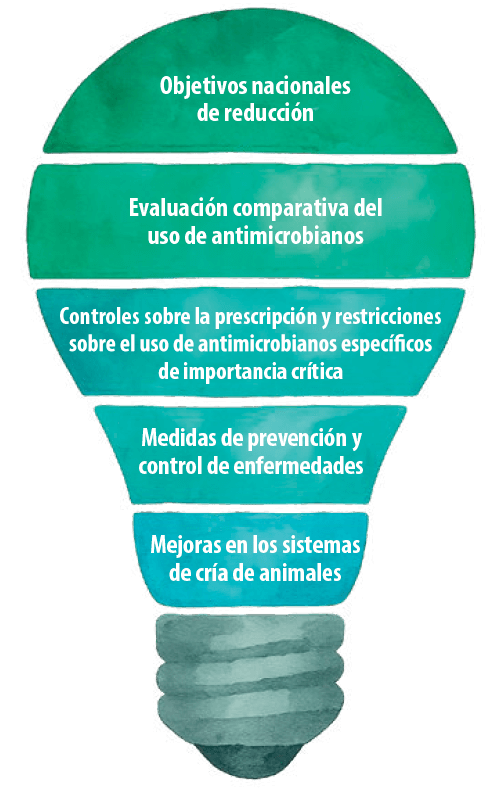
Due to the diversity of factors that can influence the development of antimicrobial resistance (AMR), it is difficult to quantify the impact of any individual measure.
Due to the diversity of factors that can influence the development of antimicrobial resistance (AMR), it is difficult to quantify the impact of any individual measure.
However, there is evidence suggesting a correlation between the reduction in antimicrobial use and the decrease in AMR.
Therefore, to achieve an effective reduction in antimicrobial use, it is essential to implement a comprehensive approach tailored to local circumstances.
ALTERNATIVE STRATEGIES TO ANTIMICROBIAL USE
Although scientific literature is still limited on alternatives to antimicrobial use, various approaches have shown promising potential to improve animal health parameters.
Among the emerging strategies are the use of:
 Probiotics and prebiotics
Bacteriophages
Immunomodulators
Organic acids
Teat sealants
All of them considered complementary or substitute options in specific contexts. |
It is essential to promote research on alternative production systems that can effectively contribute to the reduction of AMR.
 The treatment of bacterial infections must be strictly based on a precise diagnosis and an appropriate veterinary prescription, avoiding the unnecessary use of antibiotics.
It is essential to review and restrict the preventive use of antimicrobials, as well as optimize metaphylaxis through the incorporation of scientifically recognized and endorsed measures.
 In this regard, the provisions set out in Article 107(3) of Regulation (EU) 2019/6 are particularly relevant for milk yield, especially in the context of the drying off period.
BOVINE MASTITIS AND THE THERAPEUTIC PARADIGM SHIFT
Traditionally, the treatment of mastitis during drying off has been carried out through the so-called Blanket Dry Cow Therapy (BDCT), which involves the systematic administration of antimicrobials in all udder quarters.
This approach, used for decades, aims to treat existing intramammary infections (IMI) and prevent new infections during the dry period.
Recent research has shown that many cows have only one or two infected quarters at the time of drying off, which has driven the development of more selective strategies. |
Quarter Selective Dry Cow Therapy (QSDCT)
QSDCT proposes a strategy aimed exclusively at the infected quarters through:
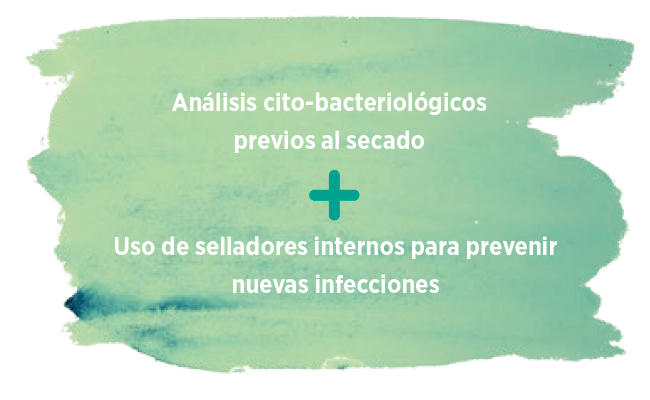
This methodology has proven to be highly effective in reducing the use of antibiotics without compromising udder health, as evidenced by a recent national study conducted in Germany.
 The study evaluated the effectiveness of QSDCT instead of systematic antibiotic treatment in all quarters (BDCT)
The research, conducted in 16 commercial dairy farms, included the analysis of 4,530 udder quarters corresponding to 1,155 dryings.
In this context, a significant reduction in the use of antimicrobials was observed, limited to 8.1% of all quarters, with percentages in some farms as low as 2.6%.
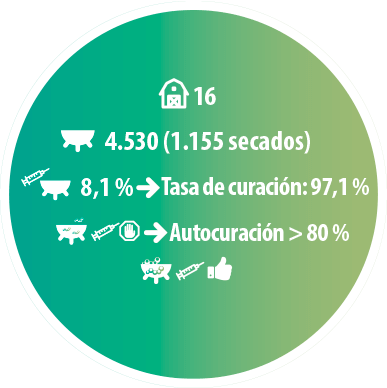
 The cure rate in quarters treated with antibiotics reached 97.1%.
The quarters affected by pathogens considered minor, such as Staphylococcus non-aureus and Corynebacterium spp., were not treated with antibiotics and yet showed self-cure rates above 80%.
 These findings support the proposition that antimicrobial treatments should be reserved for infections caused by major pathogens (e.g. Staphylococcus aureus, Streptococcus dysgalactiae, Streptococcus agalactiae, Streptococcus uberis, etc.), allowing optimization of veterinary drug use.
 These results have also been confirmed by recent studies showing that QSDCT allows a significant reduction in antibiotic use without negatively affecting udder health.
Therefore, the combination of diagnostic methods (such as bacteriological tests, California mastitis test, somatic cell count, etc.) is key for an effective selection of quarters to treat.
Use of internal teat sealants (ITS)
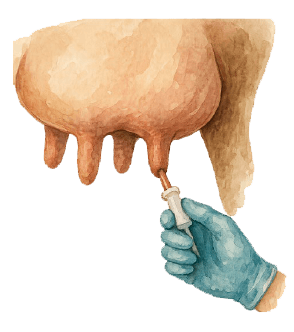
Internal teat sealants (ITS) have emerged as a non-antibiotic alternative to prevent new IMI during the dry period.
 Commonly composed of bismuth subnitrate they mimic the natural physical barrier formed by the keratin plug in the teat canal.
Their application in selective therapy programs has been effective in reducing the risk of new infections, even when used without antibiotics.
Recent studies have confirmed that ITS are a valuable tool to promote prudent use of antimicrobials. |
CONCLUSIONS
The implementation of alternative strategies to the systematic use of antimicrobials in dairy production and, particularly, in the treatment of mastitis during the drying off period, constitutes a necessary advancement aligned with the objectives of Regulation (EU) 2019/6 aimed at combating antimicrobial resistance.
The quarter selective dry cow therapy (QSDCT), by focusing solely on the infected quarters, allows for significant reduction in antibiotic administration without compromising animal health or increasing the incidence of new infections.
The combination of QSDCT with the use of internal teat sealants, based on microbiological results, represents a solid and sustainable alternative to:
 Preserve udder health
Reduce antibiotic use
Actively contribute to mitigating the advancement of antimicrobial resistance in the livestock sector
The evidence obtained in recent studies, such as the one conducted in Germany, confirms that it is possible to specifically treat the infected quarters and avoid unnecessary treatments for minor pathogens that present high self-cure rates.
The approach based on QSDCT not only represents a practice consistent with the rational use of antimicrobials, but also a sustainable way to address the growing challenge of antimicrobial resistance in the livestock sector.
BIBLIOGRAPHY
Beckmann, A., K. Barth, and K. Knappstein. 2024. Challenges in implementing quarter-selective dry cow therapy on commercial dairy farms. In IDF Animal Health Report. In press.
Beckmann, A., K. Barth, and K. Knappstein. 2023. Abschlussbericht MinimA Nachhaltige Minimierung des Antibiotikaeinsatzes durch viertelselektive Trockenstellbehandlung bei Milchkühen.
Reflection paper on prophylactic use of antimicrobials in animals in the context of Article 107(3) of Regulation 15 (EU) 2019/6.
Regulation (EU) 2019/6 of the European Parliament and of the Council, of 11 December 2018, on veterinary medicinal products and repealing Directive 2001/82/EC.
EMA and EFSA Joint Scientific Opinion on measures to reduce the need to use antimicrobial agents in animal husbandry in the European Union, and the resulting impacts on food safety (RONAFA) (2016).
Continue reading this content
Register for free or log in to access all rumiNews content.