
With the authorization in the EU of Bovacillus™, the first Bacillus-based probiotic for dairy ruminants, the conversation about gut health in cows, sheep, and goats enters new ground.
|
 We spoke with Jean-Luc Horeau, Technical Service Manager, Silage & Ruminant (France and Iberia) at Novonesis, about what sets this probiotic apart, how it works, and why the timing couldn’t be better.
 Why is the launch of the first Bacillus-based probiotic in the EU such an important moment for ruminant nutrition?
Innovation in ruminant nutrition is complicated and, therefore, an infrequent achievement: it is not enough for it to be novel, but above all, the benefits it provides must serve the animals, the farmers, the feed manufacturers, and also meet society’s expectations.
|

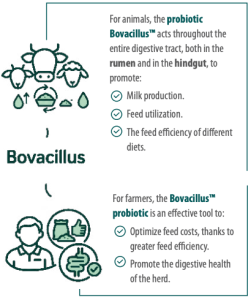
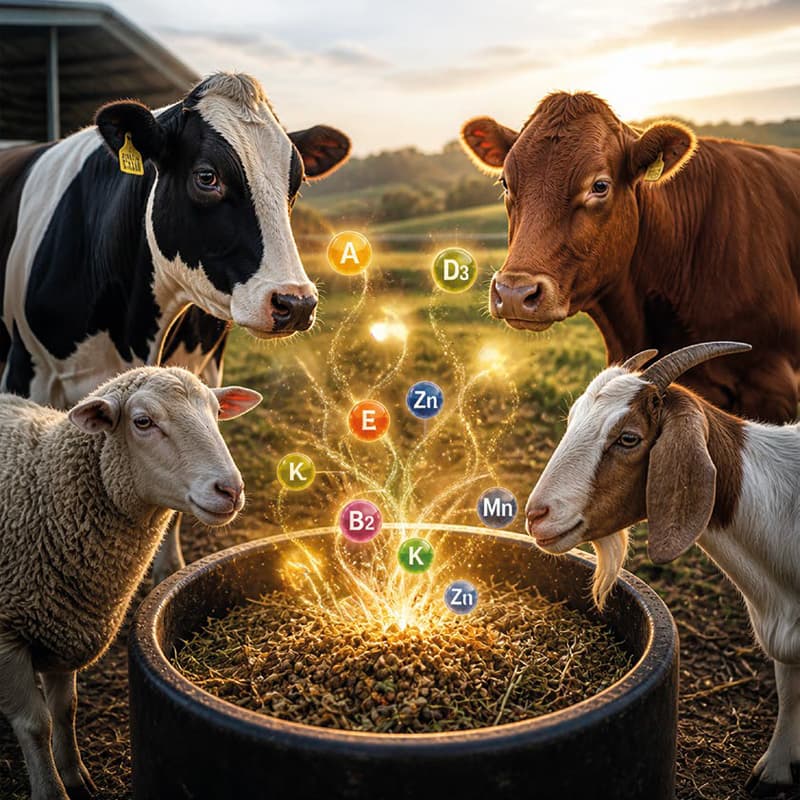
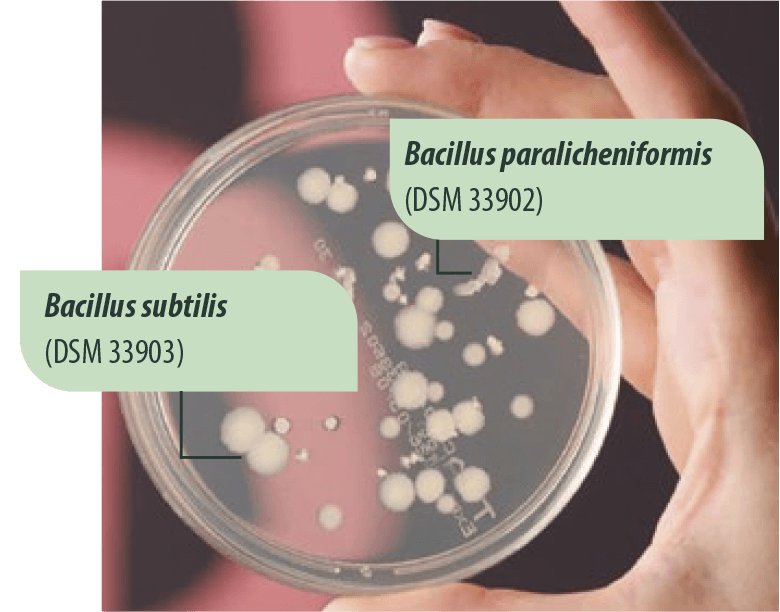
This new feed additive, composed of two strains of Bacillus specially selected for their synergy, is presented in the form of spores.
This feature makes it resistant during the feed manufacturing process.
The probiotic Bovacillus™ withstands acidic pH, lack of oxygen, high temperatures, UV rays, and pressure, so it can be used in pelleted feed, meal feed, liquid feed, minerals, or blocks.
From a sustainability perspective, Bovacillus™ offers an advantage because it allows improving animal performance and, therefore, the use of fewer resources.
However, probiotics should not be considered a universal substitute for good management, balanced diets, hygiene, or veterinary care.
What fundamentally differentiates Bacillus from the live yeast probiotics that nutritionists have been using for decades?
The probiotic Bovacillus™ is fundamentally different from the live yeast probiotics traditionally used in ruminant nutrition, as it is based on spore-forming Bacillus bacteria, instead of live yeast cells like Saccharomyces cerevisiae.
After ingestion, favorable conditions allow the spores to germinate and the bacteria to become metabolically active both in the rumen and in the hindgut. Therefore, their modes of action are very different.
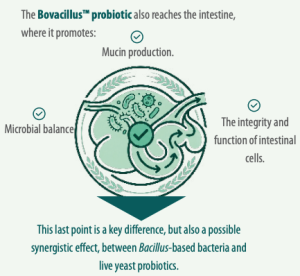
The probiotic Bovacillus™ germinates and multiplies in the rumen, but also in the intestine, where it provides additional benefits.
|
 In the rumen, it consumes oxygen and secretes digestive enzymes, such as cellulases and xylanases, which directly increase nutrient utilization, promoting a better digestibility of nutrients in a wide variety of forages, total mixed rations (TMR), and raw materials.
Bovacillus™ has multiple modes of action, from supporting intestinal integrity and immunity to influencing digestibility and the microbiome. How do these different mechanisms work together to enhance animal performance?
The Bovacillus™ probiotic enhances animal performance through a multilayered and synergistic mode of action that operates in the rumen and the lower gastrointestinal tract.
 Instead of relying on a single mechanism, its benefits come from the way various biological effects reinforce each other.
First, the Bacillus strains present in Bovacillus™ produce enzymes that help break down feed components and promote fiber fermentation.
This improves digestibility, allowing cows to obtain more energy and nutrients from the same amount of feed.
Studies have shown improvements in fiber and organic matter digestibility, which translates into greater feed efficiency for milk production. |
Regarding the microbiome, the probiotic Bovacillus™ helps maintain a more balanced microbial ecosystem throughout the digestive tract.
 By promoting beneficial microbial populations and reducing the likelihood of harmful bacteria proliferation, it helps maintain a more stable digestive environment.
A stable microbiome is the foundation of a consistent feed intake, rumen function and health, nutrient utilization, and overall herd performance.
|
 The activation of the immune system requires significant amounts of energy and nutrients in general.
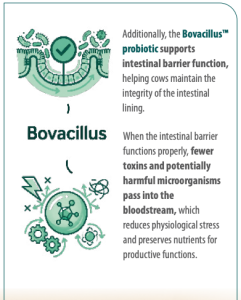
By promoting intestinal health and helping the animal manage challenges from potentially harmful bacteria, the Bovacillus™ probiotic contributes to a more efficient immune response.
As a result, less energy is allocated to immune defense and more can be directed towards milk production, growth, reproduction, and body condition.
The true value of the Bovacillus™ probiotic comes from the interaction between these different mechanisms:
 Better digestion, which translates into more nutrients available for the microorganisms and the animal.
A balanced microbiome that promotes digestive efficiency and resilience.
A stronger intestinal barrier that functions properly.
A well-regulated immune system that supports herd health.
Together, these effects improve the allocation of nutrients towards productive functions rather than maintenance. In practical terms, cows can convert more feed into milk and components (protein, fat, and lactose), while maintaining adequate health and welfare. This dual action, both in the rumen and intestines, is one of the main differentiating elements of the probiotic Bovacillus™. |

For a Spanish farmer, what are the most tangible benefits of using a Bacillus-based probiotic like Bovacillus™? How do improvements in digestibility, gut health, and resilience translate into measurable performance on the farm?
For a Spanish farmer, a Bacillus-based probiotic like Bovacillus™ can add value by improving feed utilization by cows, maintaining ruminal and intestinal function when facing common challenges such as ration changes, heat stress, calving, transport, or the pressure of potentially harmful bacteria.
 The practical benefit is not simply “better gut health,” it is more stable production and fewer costly disruptions.
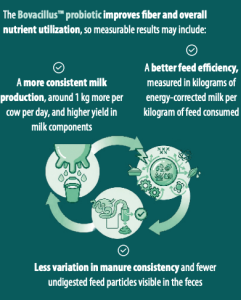
The probiotic Bovacillus™ improves the utilization of fiber and nutrients in general, so measurable results may include:
In addition to nutritional benefits, Bovacillus™ also has an effect on the immune system, and dairy ruminants generally show better health condition.
The response to Bovacillus™ depends on the quality of the forage, the ration formulation, the management, and the lactation stage of the cow. |
Why is this the right time for a Bacillus-based probiotic in dairy production? What changes in dairy farming have increased the need for this type of solution?
Dairy production is changing rapidly, creating a greater demand for reliable and preventive tools that support animal health and productivity.
A Bacillus-based probiotic like Bovacillus™ meets this need, as it is designed to support the intestinal environment, especially during stressful periods such as birth, weaning, transport, dietary changes, and health challenges.
In addition, a tool is also sought to consistently support the fiber degradation, one of the main components of the dairy cow’s diet, as it promotes the feed efficiency of the herd.
|
 The time is right to launch the probiotic
  Promoting a balanced gut microbiome from the start can thus contribute to both immediate resilience and the long-term performance of the herd.
Several changes in dairy farming have increased interest in this type of solution:
Larger and more intensive herds can increase density pressure and the speed at which infectious agents spread.
The increased focus on reducing antibiotic use has encouraged producers to adopt preventive approaches that promote health with a view to reducing antimicrobial treatment.
The more frequent management transitions, such as early weaning, automated feeding, group housing, and dietary changes, can pose a challenge to the digestion and immunity of ruminants.
Climate variability and heat stress can reduce feed intake, alter gut function, and increase susceptibility to diseases.
Fluctuations in feed quality, exposure to mycotoxins, and changes in the availability of raw materials can generate additional digestive stress.
The greater demands for efficiency and traceability mean that producers need consistent performance, fewer setbacks, and measurable results in animal health.
Together, a Bacillus-based probiotic arrives at the right time because it aligns with the sector’s evolution towards prevention, resilience, responsible use of antimicrobials, and efficient production. |
Continue reading this content
Register for free or log in to access all rumiNews content.