



Digestive pathology is one of the main diseases affecting young calves.
 It is multifactorial as its occurrence depends on the virulence and pathogenicity of the infectious agents involved and various predisposing factors, such as unfavorable environmental conditions or inadequate management (poor hygiene, poor colostrum intake, etc.).
 In recent years, due to the increase in antimicrobial resistance and the lack of new antibiotic molecules, projects focused on the One Health approach have been created.
These projects promote the prudent and responsible use of drugs to preserve their effectiveness in animals and humans and reduce the spread of resistance.
 In this regard, the study of the antibiotic sensitivity of the bacteria involved in each clinical case is a great tool for the veterinarian in the selection of the most appropriate treatment.
In this article, we will present the results of pathogen detection frequency and antibiotic sensitivity tests in bovine digestive clinical cases received at the Exopol laboratory between 2019 and 2024. |

MAIN DIGESTIVE PATHOGENS DETECTED IN SUCKLING CALVES
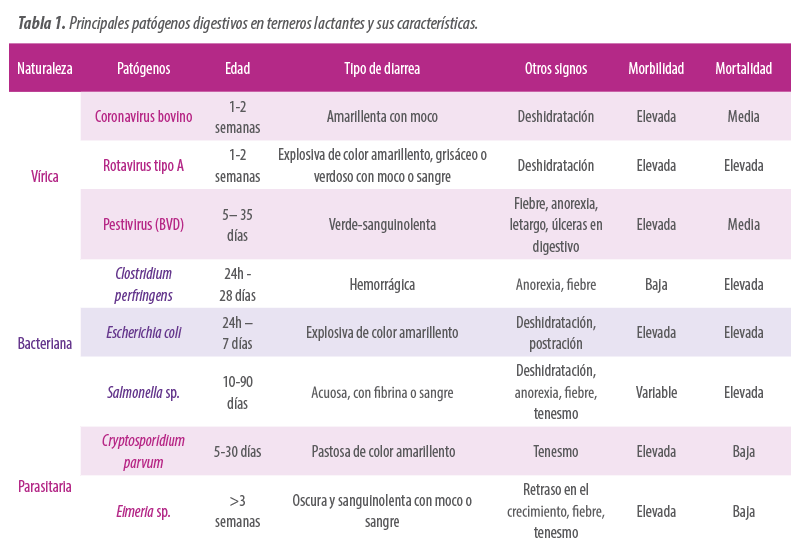
The most prevalent digestive pathogens in suckling calves are shown in Table 1.
 The age at which the diarrheal syndrome appears, the clinical signs and morbidity and mortality will help us make a presumptive diagnosis.
Torovirus, Norovirus genotype 3, and Nebovirus are considered emerging enteric viruses and their involvement in digestive processes as primary agents has been described.
 However, it is difficult to assess their involvement under field conditions because they usually appear alongside other digestive pathogens.
 The monitoring of these agents and the study of their pathogenicity will allow us to determine their true involvement in the future.
IMPORTANCE OF CORRECT SAMPLE COLLECTION
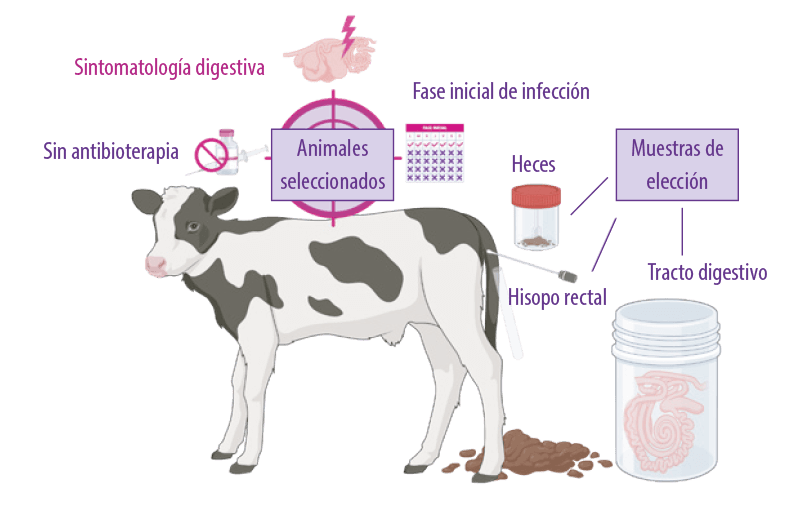
Correct sample collection is key for a conclusive diagnosis.
Animals should be selected: |
The digestive samples to be collected can be:
|

LABORATORY DIAGNOSIS
In the laboratory, different diagnostic techniques are used to identify the causal agent of enteric pathologies:
 Real-time PCR (qPCR): allows the detection and amplification of specific regions of the genome of different pathogens, obtaining a quantitative result.
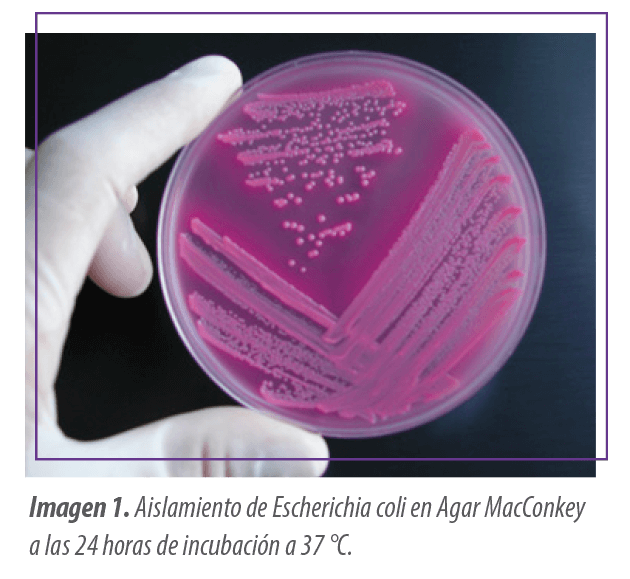
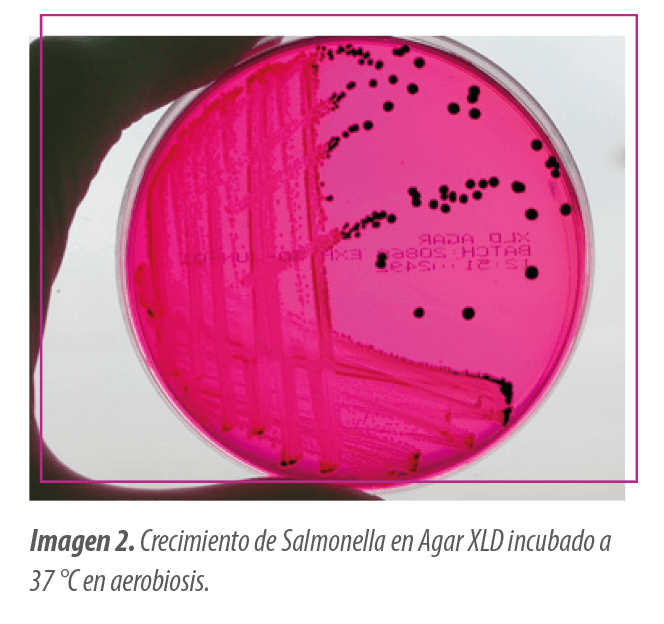
 Bacterial isolation: obtaining bacterial strains through microbiology allows for the study of antibiotic sensitivity (Images 1 and 2).
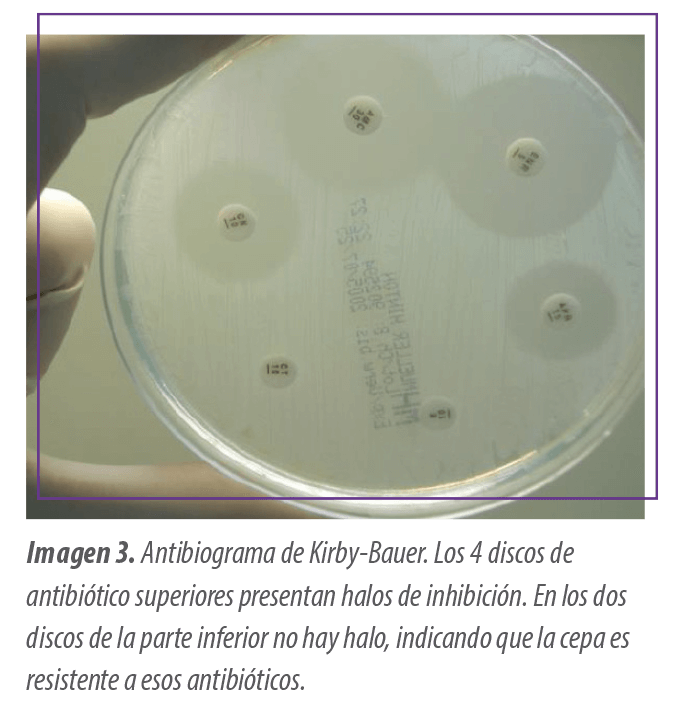
Antibiotic sensitivity test: the most used is the disk diffusion test (Kirby-Bauer), in which the bacterial isolation is exposed to a standardized concentration of antibiotic.
The inhibition zone of bacterial growth around the disk is measured (Image 3) and, according to the clinical breakpoints, the bacteria will be: Susceptible. |
 |

RESULTS OF CLINICAL CASES
The analysis of samples obtained in clinical cases provides a detailed view of the presence and distribution of pathogenic agents involved in digestive processes in cattle.
 Through the qPCR technique, the main digestive agents have been identified and, in some of them, their virulence factors. By performing bacterial isolation, the main bacteria involved have been identified, allowing for a study of their antibiotic sensitivity.
|
 The following graphs show the data obtained in recent years, allowing for the detection of trends in the frequency of detection of different pathogens and evaluating their clinical impact. Additionally, the antibiotic sensitivity results of Escherichia coli and Salmonella sp. are presented, which are fundamental for therapeutic decision-making and the design of more effective control strategies.
Prevalence of digestive pathogens in cattle
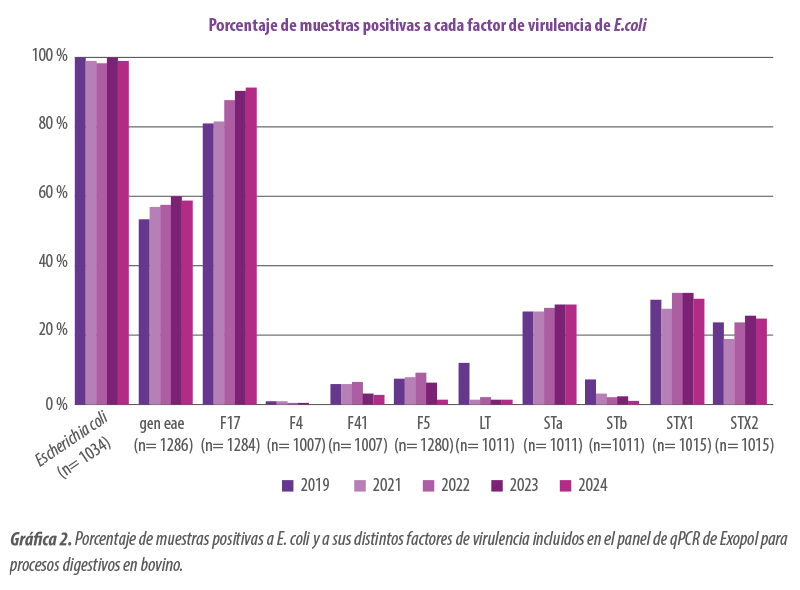
In Graph 1, a high percentage of samples positive for Clostridium perfringens and E. coli is observed. As these are commensal bacteria of the digestive tract, it is necessary to study the presence of virulence factors to assess their clinical implication (Graph 2).
 Salmonella spp., detected in 12-15% of the samples, has significant clinical relevance due to the severity of the symptoms and the difficulty in controlling them.
The most prevalent viral agent is Rotavirus type A, while the detection percentage of Bovine Coronavirus has been increasing over the years, and that of Pestivirus (BVD) has been decreasing.
 Emerging enteric viruses (Torovirus, Norovirus genotype 3, and Nebovirus) are present in 20-30% of samples in recent years, although more studies are needed to determine their relevance.
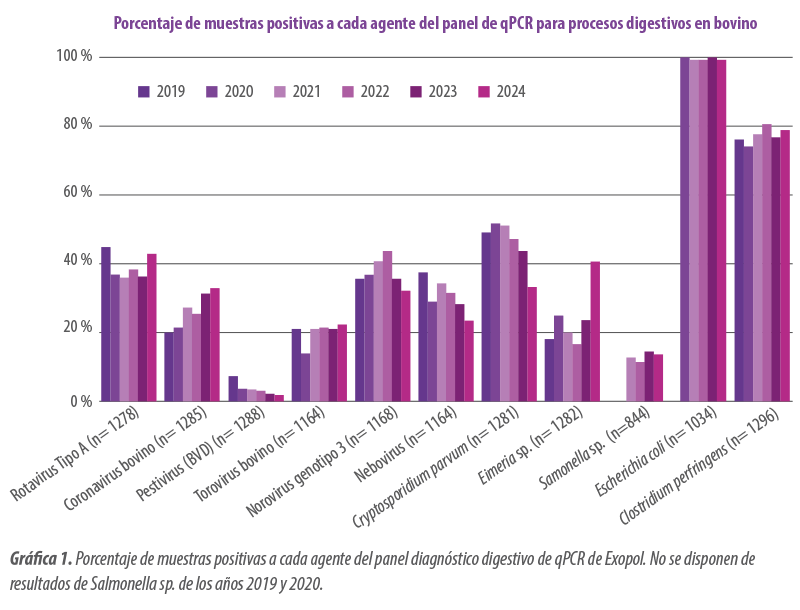
Cryptosporidium parvum is the most detected parasite, exceeding 50% of positive samples in 2020 and 2021, although a decrease in detection frequency has been observed in the last 3 years.
|
 Eimeria sp. in 2024 shows an increase in detection, we must continue collecting results to assess if there is a change in incidence.
VIRULENCE FACTORS OF E. COLI
The study of virulence factors of E. coli shows that around 30% of the cases present ETEC strains (enterotoxigenic), positive for STa, STb, and/or LT toxins.
 ETEC strains with F5 have been the most frequent in colibacillary diarrhea according to clinical practice, however, we find them in a very low percentage, this change is likely due to the regular use of vaccination.
Strains with the F17 fimbria are detected in a higher percentage, about 90%.
Approximately 60% of the samples analyzed are positive for EPEC strains (enteropathogenic, eae gene) and in 30% of the cases, we observe the presence of STEC strains (shiga toxin-producing STX1 and STX2) and EHEC (enterohemorrhagic, eae gene and STX1 or STX2).
 VIRULENCE FACTORS OF C. PERFRINGENS
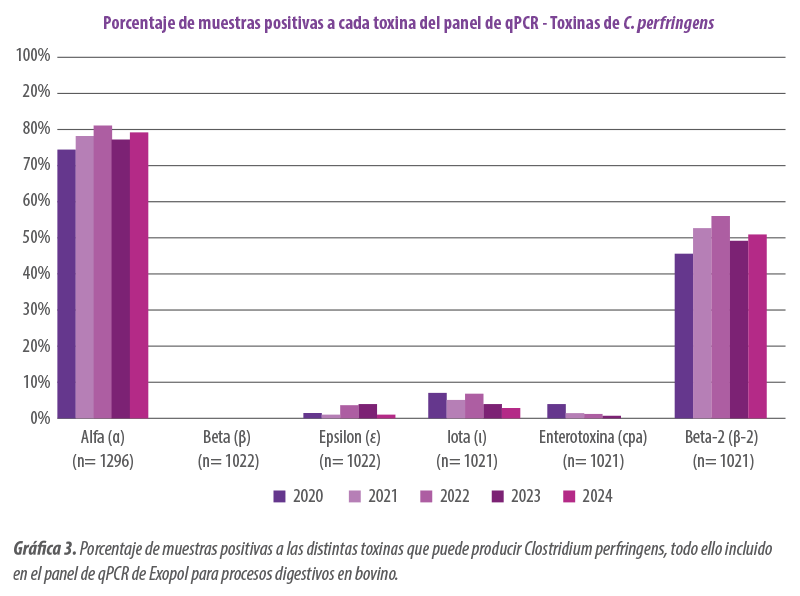
Clostridium perfringens type A (produces only α toxin) is the most predominant toxinotype. The toxinotype D (α and ε toxin) and E (τ toxin) are also detected, but with a much lower incidence. The β-2 toxin is detected in 50% of positive samples, and the strains capable of producing it have greater virulence.
Antibiotic sensitivity results of E. coli
CATEGORY D
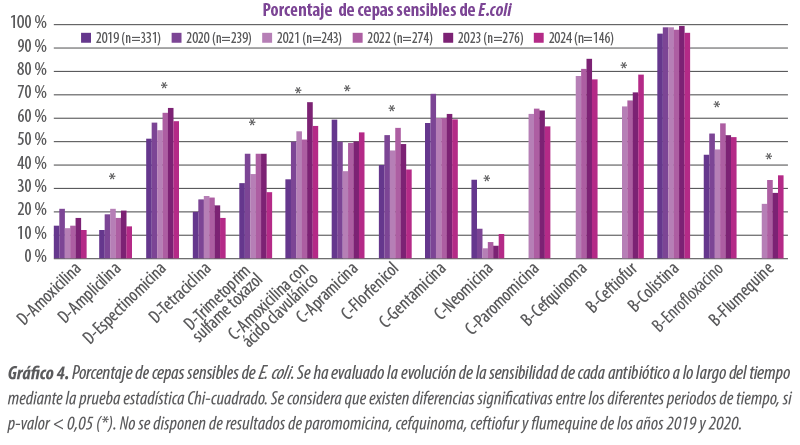
 Spectinomycin is the only category D (first choice) antibiotic effective against more than 50% of tested strains (Graph 4).
 The combination with lincomycin is used in digestive infections by E. coli although lincosamides (lincomycin, clindamycin) have no activity against most gram-negative bacteria such as E. coli and Salmonella sp. The combination of spectinomycin and lincomycin presents a broad spectrum of action.
CATEGORY C
Most antibiotics in category C show percentages of sensitive strains around 60%.
 The most concerning case is that of neomycin (aminoglycoside) with a significant decrease in sensitivity in recent years possibly caused by its frequent use in other animal species.
Other aminoglycosides such as gentamicin and paromomycin show better results (more than 60% of sensitive strains).
CATEGORY D
Most antibiotics analyzed in category B show good sensitivity results.
However, flumequine is effective in less than 40% of the tested strains and enrofloxacin has less than 60% of sensitive strains.
Antibiotic sensitivity results of Salmonella sp.
CATEGORY D
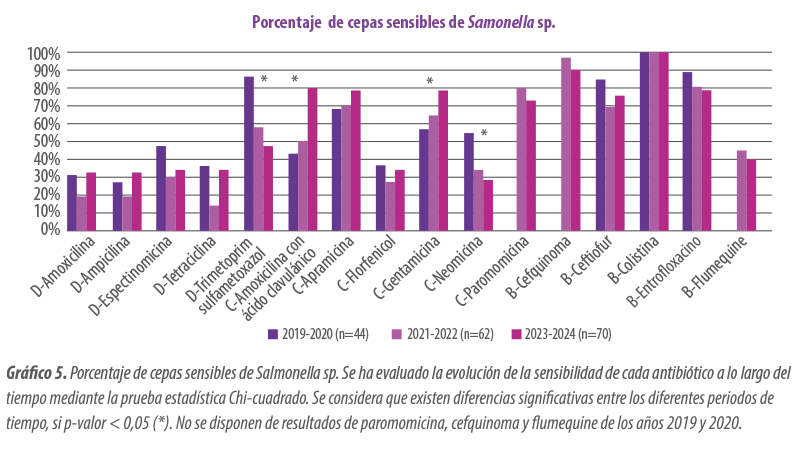
From category D, all antibiotics except trimethoprim-sulfamethoxazole achieved less than 50% of Salmonella strains sensitive (Graph 5). Additionally, trimethoprim-sulfamethoxazole shows a statistically significant drop in the percentage of sensitive strains in recent years.
CATEGORY C
Antibiotics in category C show better results, such as apramycin, paromomycin, amoxicillin with clavulanic acid, and gentamicin.
It is noteworthy that neomycin shows a statistically significant decrease in sensitivity in recent years with only 29% of strains sensitive in 2023-2024.
CATEGORY B
Flumequine, from category B, is registered for the treatment of salmonellosis, but shows low sensitivity percentages (40%) in the years 2023 and 2024. The rest of the antibiotics in category B show very good sensitivity results.
CONCLUSIONS
We observe that Rotavirus type A is the most frequently detected virus, Cryptosporidium parvum the most relevant parasite, and the detection percentage of Eimeria sp. has increased in the last year.
The virulence factors F17 and eae gene of Escherichia coli are detected in the highest percentages, and Clostridium perfringens type A is the most frequent toxinotype in digestive processes.
The E. coli strains analyzed show low percentages of sensitivity to most antibiotics in categories D and C, but are better in category B. In the case of Salmonella sp., better sensitivity results are observed than in E. coli.
In both cases, it is necessary to perform antibiotic sensitivity tests before establishing a treatment.

BIBLIOGRAPHY
CLSI. Performance Standards for Antimicrobial Disk and Dilution Susceptibility Tests for Bacteria Isolated From Animals. 4th ed.
CLSI supplement VET08. Wayne, PA: Clinical and Laboratory Standards Institute; 2018.
European Medicines Agency, Classification of antibiotics for use in animals for prudent and responsible use, 2019,
Full AMEG report: https:/bit.ly/30ZEuRi
Schwarz S., Cavaco L.M., Shen J., 2018. Antimicrobial resistance in bacteria from livestock and companion animals, ASM Press. Washington DC. ISBN: 9784555819798
Continue reading this content
Register for free or log in to access all rumiNews content.