
Interview with Alfonso Martínez – Veterinary Technical Advisor
What is Bovalto Respi Intranasal?
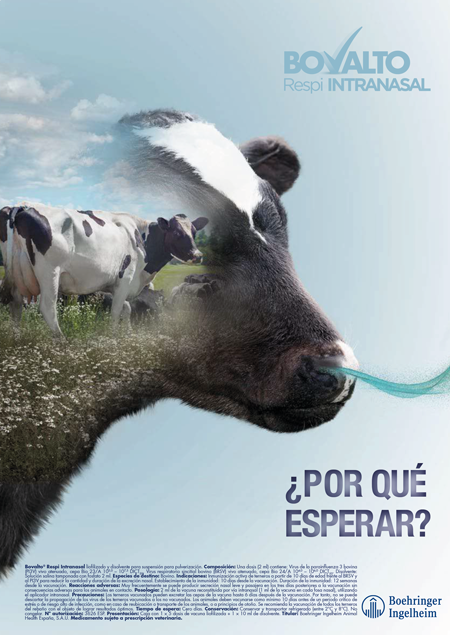
Bovalto Respi IN is a new vaccine against two of the most important viruses among the etiological agents of Bovine Respiratory Disease (BRD), administered intranasally and generating a very rapid immune response in very young calves (from 10 days of age) even in the presence of maternal antibodies.
With the incorporation of this product, the Bovalto Respi vaccine range is completed. What strengths define this range of vaccines?
It is clear that BRD remains the pathology with the greatest impact on bovine production of any aptitude worldwide.
Considering the type of disease and the increasing importance of prevention, as well as the restrictions on the prophylactic use of antibiotics, it was necessary to update the strains of the microorganisms responsible for BRD used in vaccines globally.
This is one of the great contributions of the Bovalto Respi vaccine range from Boehringer Ingelheim, as the strains included are derived from field isolations of current strains of the etiological agents of this very important pathological complex.
Moreover, the absence of Bovine Herpesvirus type I strains, the cause of IBR, in all vaccines in the range, allows adapting the vaccination programs of farms to the new situation presented in Spain from January 1, 2019.
From that moment, the use of non-marked vaccines against IBR will be prohibited and a control and eradication program for this bovine disease will begin in Spain.
Alongside these aspects, the different antigenic composition of the three vaccines in the Bovalto Respi (BR) range provides great flexibility in designing vaccination programs, allowing us to immunize animals from very early ages (BRIN) and decide against which pathogens and at what time we want to complete that initial immunization, including or not another very important virus such as BVDV.
In which countries is Bovalto Respi Intranasal being launched?
The launch is planned in all European countries, and Spain will be one of the first to launch the new vaccine due to the importance of fattening young animals in our country and also as a result of the success of BR3 and BR4 since their launch in 2016.
What is its composition?
Bovalto Respi IN includes in its composition two of the four most important viruses within the BRD complex.
The modified live strains of the Bovine Respiratory Syncytial Virus and Bovine Parainfluenza Virus have been included in the vaccine due to their high pathogenic power (they are capable of causing lung tissue damage on their own) and their ability to pave the way for secondary infections by other viruses and, especially, by Mannheimia haemolytica, which is the most prevalent bacterium and causes the most deaths among animals affected by BRD.
The vaccine is specifically designed to be administered intranasally as an aerosol, generating a very potent immunity right where it is needed, which is in the nasopharyngeal mucosal tissue, the entry point for all BRD agents.
In this way, we block the pathogens and prevent them from accessing the lower respiratory tract, avoiding the development of lung lesions and the establishment of the respiratory complex.
What are its indications?
Bovalto Respi Intranasal is indicated for the active immunization of calves from 10 days of age against infections by BRSV and PI3V and to reduce the amount and duration of excretion of both viruses.
Additionally, it provides a rapid establishment of immunity (OOI) 10 days after vaccination. This immunity lasts (DOI) up to 12 weeks after vaccination with a single dose. Both the OOI and DOI have been demonstrated by virulent challenge against both viruses in vaccinated animals.
One of the great advantages of this vaccine over other market options is that it has demonstrated efficacy in the presence of maternal antibodies, meaning that the presence of passive immunity acquired through colostrum does not interfere with the immune response generated by vaccinating very young animals with Bovalto Respi Intranasal.
What is the importance of mucosal immunity in the calf?
Mucosa-associated lymphoid tissue (MALT) represents, in total, the largest component of the immune system of higher animals, so that, at any given time, approximately 80% of defense cells are located in the MALT.
Within the MALT, the diffuse lymphoid tissue and nasopharyngeal tonsils play a fundamental role in immune defense against pathogens entering the body via the aerogenic route, just as the lymphoid tissue associated with the digestive mucosa protects the body against pathogens entering through that route.
Moreover, the immune response generated in the mucosa of the upper airways after vaccination with Bovalto Respi Intranasal is very rapid and potent, so the animals are protected in the most critical and high-risk phases at the start of their rearing period in the feedlot, especially when handling very young suckling animals.
This mucosal immunity, based on soluble immunoglobulins, is capable of blocking the access of viruses to the body at their very entry point, generating a very effective and highly protective blockade.
But, at the same time, this initial IN immunization can be reinforced and completed later through a parenteral vaccination protocol with BR3 or BR4, as all BR range vaccines contain the same strains in their modified live (BRIN) or inactivated (BR3 and BR4) versions.
This fact represents a great advantage when designing complete vaccination programs aimed at generating long-term immune protection.
What are the advantages of intranasal application?
The main advantage of intranasal vaccination with Bovalto Respi IN is, as we have already mentioned, the potent stimulation it produces on the NALT and, therefore, the establishment of very effective immunity at the entry point of all pathogens (viruses and bacteria) responsible for BRD.
Likewise, the intranasal route is very safe and harmless, so it very rarely generates post-vaccination adverse reactions and, if any, they are very mild and consist of a short period of serous nasal discharge without consequences.
We also do not generate pain and the stress associated with it in animals that, in most cases, are already stressed and very young, which is a great advantage in achieving good levels of animal immunity.
Furthermore, it is also important to consider that the intranasal route requires a lower metabolic expenditure to generate an immune response, so no extra energy expenditure is demanded from animals entering the feedlot in negative energy balance.
In reality, vaccination through mucosal surfaces is, from an immunological point of view, the best option for animals of any age, but it is better suited to the management of young animals in the rearing and growing phases (whether for fattening or replacement).
What application device is recommended?
Our proposal for vaccine application brings innovations and great advantages. It is a high-quality multidose dispenser, already well tested at the field level, to which a novel nebulizer is attached that guarantees the optimal and constant size of the vaccine droplets between 30 and 100 microns.
This droplet size has a fundamental effect on the efficacy of IN vaccination, as it:
- Prevents dose loss (when the droplet is too large)
- Ensures antigen deposition in the NALT (where we want the immune response to be triggered)
- Prevents antigen passage to the lungs (when droplets are too small), which could generate undesired effects due to the replication of vaccine viruses
Another great innovation is that Boehringer Ingelheim has developed a device (Breezer) that prevents the nebulizer from damaging the nasal mucosa and, therefore, the inflammation of it that could reduce the vaccine’s efficacy and cause discomfort in the animals.
In what format is it marketed?
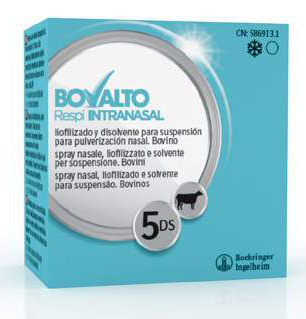
For now, it will be marketed in vials of 5 doses. This decision is also a consequence of the survey conducted among farmers and veterinarians across Europe.
This format fits very well with the size and needs of most European farms, although the launch of other presentations in the future is not ruled out.