
Talent management (attracting and retaining) has become one of the major challenges for the livestock sector. The high turnover rate and difficulty in filling certain positions are not new phenomena, but in recent years they have taken on a more structural and persistent dimension.
One of the key factors is the growing competition with other economic sectors that offer conditions perceived as more attractive, especially in terms of schedules, stability, or career prospects.
 Areas such as services, logistics, or commerce concentrate a high volume of job opportunities, which increases the pressure on livestock farms when it comes to attracting and retaining qualified professionals.
Ruminant farms face the challenge of differentiating themselves and highlighting aspects that go beyond the job itself: |
 Technical specialization.
|
 In light of this reality, talent management ceases to be a secondary aspect and becomes a key element for the sustainability and competitiveness of the sector, requiring a proactive approach focused on identifying opportunities and acting strategically.
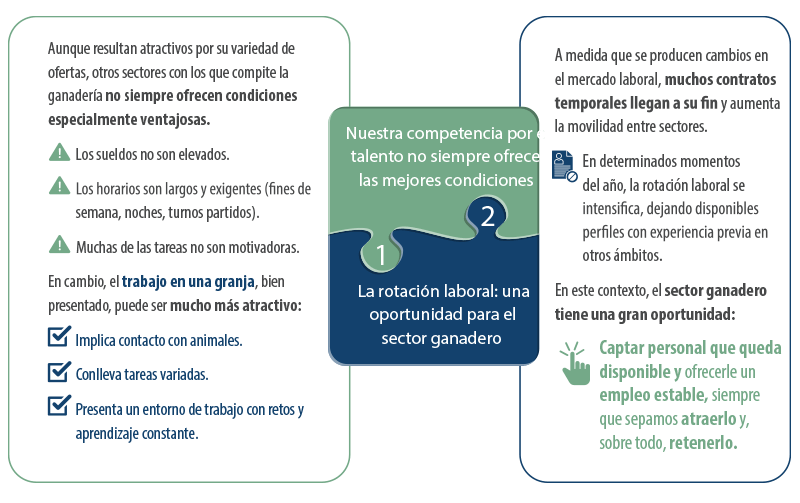
There are two key aspects to analyze when we talk about competition for talent:
HOW TO ATTRACT NEW TALENT?
The first step is to generate interest in the sector, as many potential workers have a negative or distorted image of working on a farm:
 They think it is a monotonous, physically demanding activity carried out in an unpleasant environment.
To change this perception, we must clearly communicate the positive aspects of working on a farm.
For example:
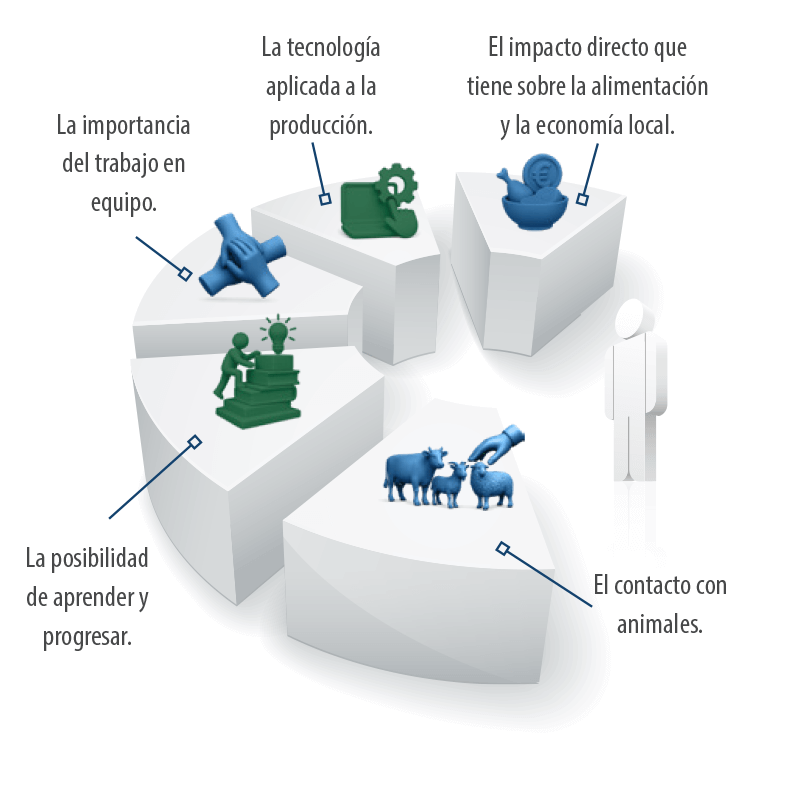
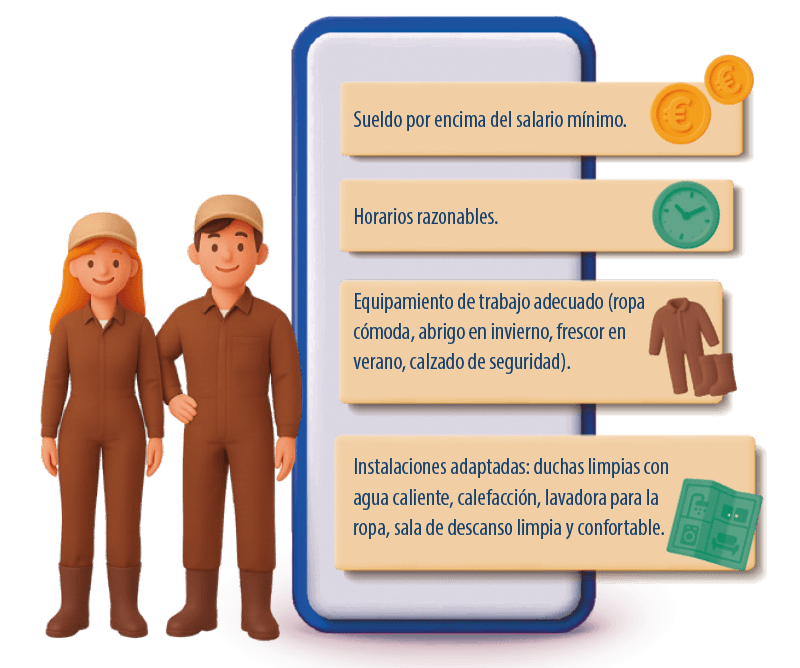
This must be complemented by a fundamental basis of decent conditions:
HOW TO ENSURE THEY DON’T LEAVE?
Various studies agree on the factors that make a person stay in their job. Some of them are:
 Communication and recognition
It is essential that the worker knows what is expected of them, receives regular communication (and respectful), and has spaces for constructive feedback.
 Most people do not leave the company, but their direct supervisor.
Good work environment
The atmosphere in the workplace is a determining factor.
Promoting pleasant moments, relaxation spaces, and a culture of respect generates cohesion.
Gallup includes among its engagement indicators the question: “Do you have a friend at work?”
The sense of belonging is key: when someone does not feel included, they tend to leave or, in the worst case, sabotage the environment.
Training and development
A clear career plan, continuous training, and tailored skills development are essential.
The feeling of progress, of gaining mastery, of improving, is one of the most gratifying and motivating. But no one is born knowing, and space must be given for learning.
Purpose and meaning
People need to understand the “why” of what they do. This includes both the simplest tasks and the overall impact of the work.
On a farm, we feed the world, generate employment, and boost the rural environment. Participating in local activities, collaborating with social or environmental initiatives in the area gives a deeper meaning to the work and fosters commitment.
THE SECTOR’S CHALLENGE: ADAPTING TO NEW GENERATIONS
This is where we need to pause. It’s not just about attracting talent, but about adapting the sector to new needs and lifestyles.
 It’s neither negative nor judgmental that people want to have better quality of life, spend more time with their family or hobbies, and not feel enslaved by work.
The new generations have different priorities, and the sector must listen to them! Resisting change is a waste of energy. |
 The future involves opening our minds and exploring new ways of working:
Rotating shifts that allow for work-life balance.
Intensive schedules that free up the afternoons.
Real flexibility adapted to each context.
Continuous improvement in training, digitalization, and team specialization.
Technology: it allows us to optimize resources, reduce repetitive tasks, and improve the quality of the work environment. Sensors, cleaning robots, automatic feeding or climate control systems… All this makes work more efficient and, at the same time, more human.
There is also much talk about the lack of commitment from the new generations. However, the data does not invite finger-pointing: according to the latest Gallup reports, only 21% of workers are engaged with their job. |
The real motivation is closely related to three major psychological needs:
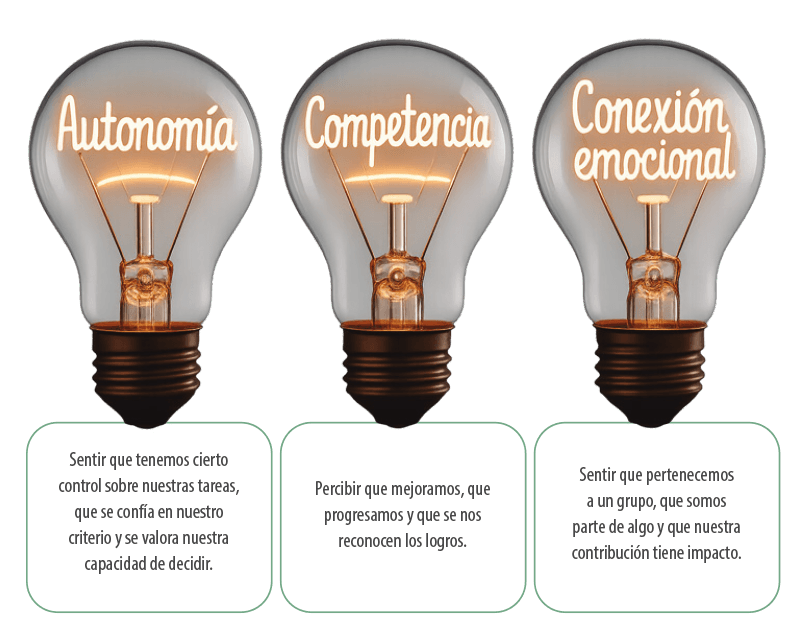
If a farm wants to attract and retain talent, it must consider these elements.
It’s not about big investments, not everything is the fault of the new generations. It’s about changing the approach: from control to respect, from fear to trust, from complaint to proposal.
Now is the time! |
 Transforming the workplace into a space where people want to stay is the most important challenge to ensure the sustainability of our sector.
Continue reading this content
Register for free or log in to access all rumiNews content.