


Respiratory processes are one of the main health and productivity issues in the small ruminants sector.
Ovine Respiratory Complex (ORC)
The emergence of the ORC is favored by various predisposing factors such as certain environmental conditions, management, and stress situations.
Traditionally, the following bacterial agents were described as participants in the ORC:
- Mannheimia haemolytica
- Pasteurella multocida
- Bibersteinia trehalosi
- Mesomycoplasma ovipneumoniae
However, currently the study of respiratory viruses is a clear research objective, as they have been described on rare occasions.
In this article, we will discuss the involvement of the Caprine Parainfluenza Virus Type 3 (CPIV3) in the ORC and its presence in the livestock of the Iberian Peninsula. |
WHAT IS THE PARAINFLUENZA VIRUS TYPE 3?
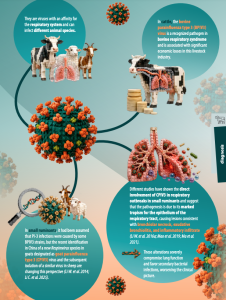
Parainfluenza Virus Type 3 belongs to the Paramyxoviridae family and the Respirovirus genus.
STUDY ON CAPRINE PARAINFLUENZA VIRUS TYPE 3 IN SPAIN
Development of a new diagnostic tool
The identification of CPIV3 in our region was carried out preliminarily on 60 respiratory clinical cases in sheep and goats, using two real-time PCR assays (qPCR):

 CPIV3 Assay: a previously described assay by Li et al. 2016b.
Pan PI3 Assay: a proprietary assay designed to generally identify ruminant Respirovirus.
All samples from the preliminary study were negative for the CPIV3 assay by Li et al. However, 53% (32/60) of the cases were positive for the general assay (Pan PI3), indicating the possible presence of a Respirovirus in the samples.
The subsequent sequencing of the viral nucleocapsid (N) gene in these positive samples confirmed the presence of a virus related to CPIV3, but it exhibited genetic differences that grouped it into a separate cluster from the previously identified strains (Figure 1).
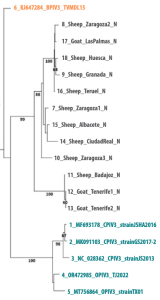
Figure 1. Phylogram of the N gene for the goat parainfluenza type 3 (CPIV3) strains identified in Spain (black) compared to previously described CPIV3 isolates (green) and BPIV3 (orange)
 The sequences obtained demonstrated that at the N gene level, the viruses in this study showed a nucleotide homology of 89-92% with the CPIV3 strains previously described in China, while with the bovine virus (BPIV3) it was less than 82%.
 These results confirmed that the circulating virus belonged to the CPIV3 group, but to a different genetic variant.
Differences were also observed among the viruses identified in this study, with nucleotide homologies of 85-99% among the different strains.
Based on the sequences obtained, a new specific qPCR assay was designed to detect the Parainfluenza type 3 viruses identified in this study, as well as the CPIV3 strains previously described (SRPI assay). |
Identification of Parainfluenza 3 virus in small ruminants
The SRPI assay was used to analyze 1,333 respiratory clinical cases received in our laboratory between 2021 and 2024 from 46 Spanish provinces (n=1261) and different regions of Portugal (n=72). Of these, 1,009 corresponded to sheep and 324 to goats.
The use of this assay allowed the detection of the virus in 25% (333/1,333) of the cases analyzed.
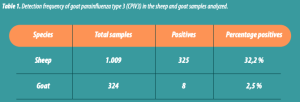
However, very marked differences were found between species (Table 1), as the detection frequency in sheep was 32.2%, in contrast to only 2.5% positivity in goat samples.
Although this virus was initially identified in goats and was named Caprine Parainfluenza Type 3, the results indicate that its epidemiological importance in the Iberian Peninsula could be greater in sheep.
FREQUENCY OF DETECTION BY SAMPLE
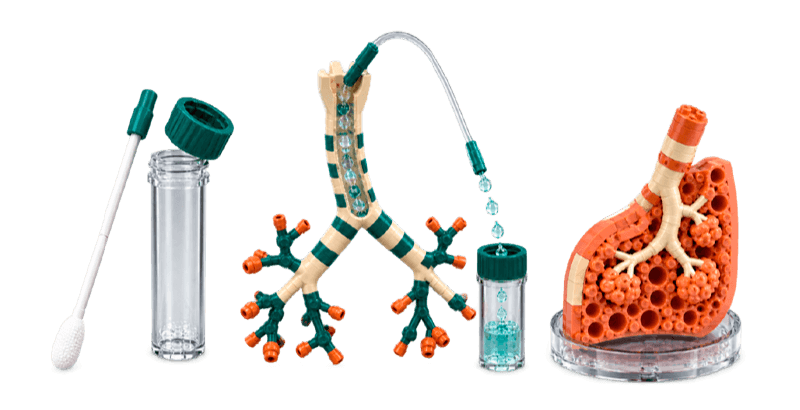
The results obtained based on the type of sample received (respiratory swabs, tracheobronchial washes, and lung tissue) are detailed in Table 2.
The virus was detected in all three types of samples analyzed, with a slightly lower detection rate in the lung.
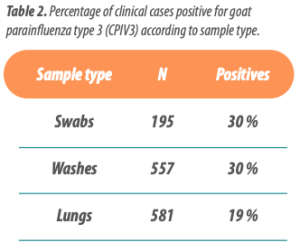
These differences may be related to the phase of the infection/disease, as it is common for samples collected from live animals to come from acute or more recent infections and, therefore, increase the probability of detecting primary viral agents, than samples obtained postmortem, where it is more likely that lung lesions are more chronic. |
DETECTION FREQUENCY BY AGE
When studying the positive results obtained according to age, significant differences were observed (Figure 2):
The fattening animals showed the highest detection frequency, with approximately 49% positive cases.
The virus was only identified in about 2% of adult animals.
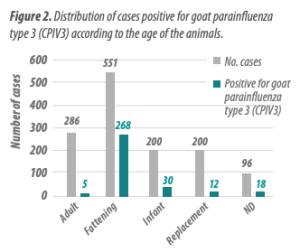
On the other hand, in suckling animals CPIV3 was detected in 15% of the samples analyzed. When assessing the viral load present in the samples, the suckling animals showed higher concentrations of the virus than the fattening animals, suggesting that young animals might be especially susceptible to infection and virus multiplication (Figure 3).
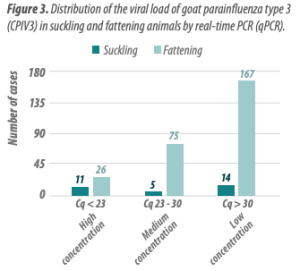
The immaturity of the immune system, the reduction of maternal immunity as the weeks of life progress, and the concentration of animals in artificial lactation systems could contribute to this greater susceptibility. |
Implication of CPIV3 in the Respiratory Complex
The study was completed by evaluating the most prevalent agents involved in respiratory pathology. Regardless of age, the following pathogens were analyzed by qPCR:
- Pasteurella multocida
- Mannheimia haemolytica
- Bibersteinia trehalosi
- Mesomycoplasma ovipneumoniae
Additionally, in replacement and adult animals, the identification of retroviruses causing Maedi/Visna or CAE and Ovine Pulmonary Adenocarcinoma was carried out.
In 49% of the clinical cases analyzed, CPIV3 was detected in coinfection with one or more of the pathogens, mainly with Pasteurella multocida, Mannheimia haemolytica and/or Mesomycoplasma ovipneumoniae. However, in four cases this Respirovirus was the only pathogen identified, suggesting its role as a primary agent in the respiratory pathology of small ruminants. |

CONCLUSIONS
The results obtained in our study report the circulation of a Respirovirus variant in small ruminants of the Iberian Peninsula, genetically distinct from the CPIV3 strain previously described in China.
The design of a new qPCR assay for the identification of this agent allowed the detection of CPIV3 in a considerable percentage of clinical respiratory samples from small ruminants.
 The results also indicate that young animals show a higher susceptibility to infection, not only due to the frequency of positive cases but also because of the high viral load, suggesting a relationship between susceptibility to infection and the age or productive stage of the animal.
These findings underscore the great genetic diversity of the Parainfluenza 3 virus in small ruminants and the need to consider this agent as involved within the ovine and caprine respiratory complex, as well as in future control programs. |
Continue reading this content
Register for free or log in to access all rumiNews content.