


Risk Assessment of Mastitis in Dairy Sheep Herds
 Milk Quality Under Review
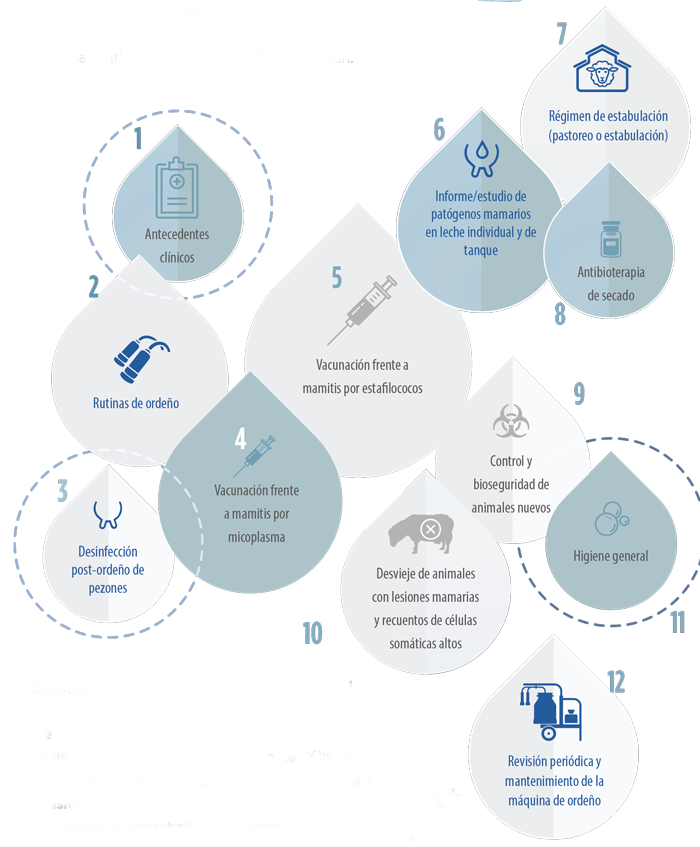
In order to provide a comprehensive service to improve the milk quality of the farms of the Sheep Promotion Consortium (CPO), a total of 326 milking facilities were evaluated in 2017, and a 12-point risk assessment audit for mammary infection was conducted in the critical areas detailed below:
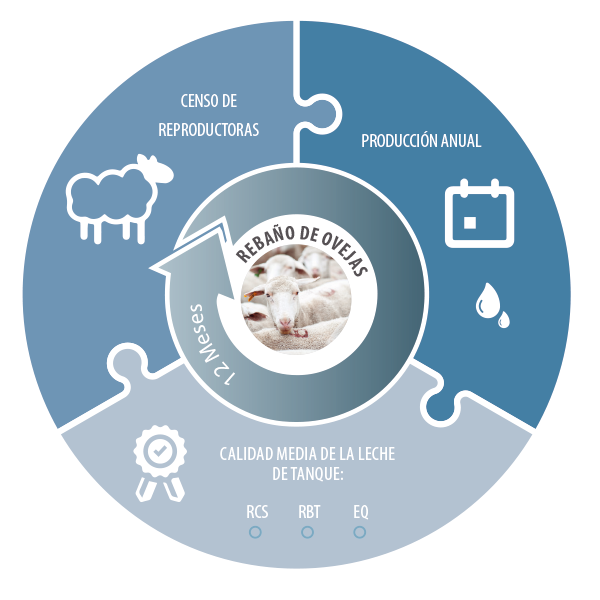
 The ultimate goal of this scrutiny was to assess the impact of the milking machine and the audit score (risk points) on the hygienic-sanitary quality (SCC: Somatic Cell Count and TBC: Total Bacteriological Count) and physicochemical quality (CE: Cheese Extract) of the bulk tank milk from the evaluated herds.
 THE MILKING FACILITY
Regarding the evaluation of the milking facility, we assessed a total of 23 parameters related to:
- The correct operation and regulation of the milking machine
- The proper maintenance and cleaning of the surfaces in contact with the milk
 AGE
AGE
The study showed an average age of the CPO facilities of 16.3 years, with 3.2 years being the average period since the last review/check of them.
 VACUUM PUMP
The average flow rate of the pump per milking unit at 50 kPa was 107 l/min, which initially seems a satisfactory flow to meet the milking and reserve needs.
The manual reserve per milking unit was 123.4 l/min, sufficient to address potential regulator leaks and adventitious air entries during milking.
The milking vacuum was 36.1 kPa, with the speed and pulsation ratio of the teat cups being 161 ppm and 57.3% respectively.
Overall, these average values can be considered adequate for a satisfactory and minimally traumatic milking.
Data were recorded on each sheep herd for the 12 months immediately preceding the milking facility check.
The technical parameters of the milking machine showed correlation coefficients always below 0.20 with the SCC, TBC, and CE of the bulk tank milk, with this correlation being statistically significant for some of the milking machine parameters (pump flow and reserve, air consumption, and pipe diameters per milking unit).
The 12 risk points assessed in the audit were scored with grades from 0-1 (0 = satisfactory, 1 = Deficient), yielding final results between 0 and 12, allowing us to group the farms into 3 risk groups (Low, Medium, and High).
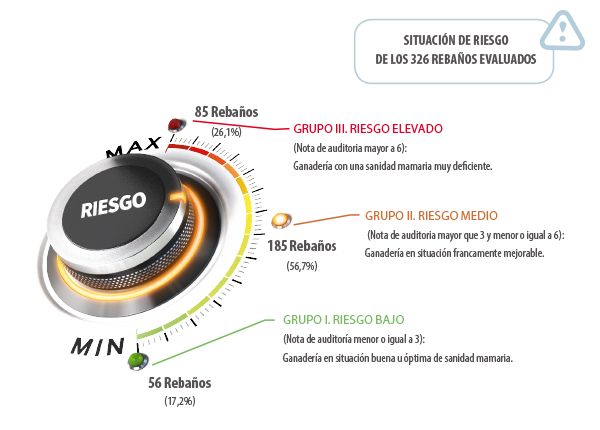
The results of this study showed a total of 56 sheep herds in optimal condition (17.2%), 185 herds with a clearly improvable situation (56.7%), and 85 herds with very poor risk (26.1%), with Table 1 showing a relationship between the audit scores and the final production and quality of the bulk tank milk of the sampled herds, also showing:
- A negative relationship between the audit score, the milk yield and gross income per sheep per year.
- A positive relationship between the audit score and the cell count, the bacteriological count, and the cheese extract of the milk.
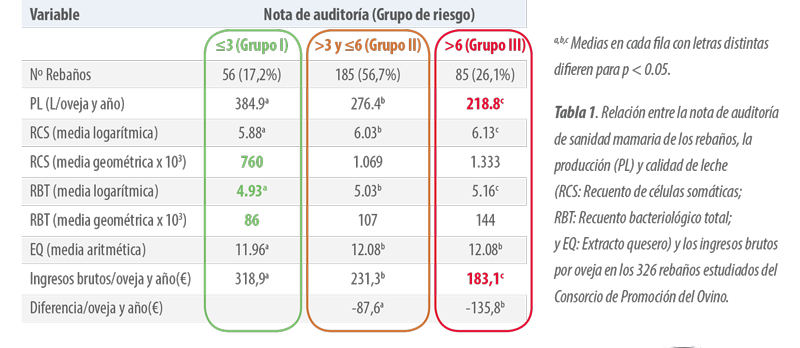
The increase in cheese extract in herds with higher audit scores is associated with the increase in the presence in the milk of immunoglobulins and other proteins from the blood in sheep with subclinical mastitis and, therefore, in the bulk tank milk of herds with higher prevalences of mastitis, noting that such proteins lack cheese value.
Conclusions
The study of correlation between the main technical parameters of the milking machine (pump flows, consumption, and pipe diameters per milking unit) and the milk quality, indicates that these parameters –considered individually– would explain up to 4% of the variations in bulk tank milk quality, highlighting the good general condition of the evaluated milking facilities.

Regarding the audits of herd mammary health, as the audit score increases, milk yield per sheep per year decreases and quality worsens (higher cell and bacteriological counts), resulting in significant economic losses in our herds.

Indeed, compared to herds with audit scores below 3 risk points (Group I: optimal mammary health condition), herds with scores between 3 and 6 (Group II) have economic losses per sheep per year of 87.6 euros, while such losses rise to 135.8 euros per sheep per year in herds with scores above 6 (Group III).

Acknowledgments: To Dr. Carlos Gonzalo Abascal and Dr. Luis Fernando de la Fuente Crespo, for their collaboration and statistical advice. References will be provided upon request.
Continue reading this content
Register for free or log in to access all rumiNews content.