A POLARIZED DEBATE IN THE FACE OF A COMPLEX REALITY
Contemporary debates on livestock and meat consumption are often dominated by a negative and exaggerated environmental interpretation, widely disseminated since the publication in 2006 of the FAO Livestock’s Long Shadow report.
The following points are often put forward as central arguments in favor of a drastic reduction in animal production —or even its replacement by plant-based or lab-grown alternatives:
 The methane emissions associated with ruminants.
The deforestation linked to soybean cultivation for animal feed.
The competition between animal feed and human food.
The high water footprint attributed to beef.
This approach is caricatured, lacks nuance, and remains partial.
It tends to isolate or misuse certain indicators (greenhouse gases, water consumption, protein yield) without integrating all the ecological, agronomic, economic, social, and cultural dimensions of livestock farming.
The article by Peyraud and Hocquette (2025) proposes overcoming this fragmented view and offering a multidimensional, nuanced, and balanced interpretation that considers not only the negative impacts but also the ecosystem and social services provided by livestock systems, especially those based on grasslands.
CARBON FOOTPRINT: AN INDICATOR THAT REQUIRES NUANCE
Livestock is part of the global balance of greenhouse gas (GHG) emissions. According to recent FAO estimates, it is attributed around 12% of anthropogenic emissions worldwide.
Within this group, cattle represent the main contribution, largely associated with methane emissions from enteric fermentation.
However, several elements invite caution when interpreting these figures:
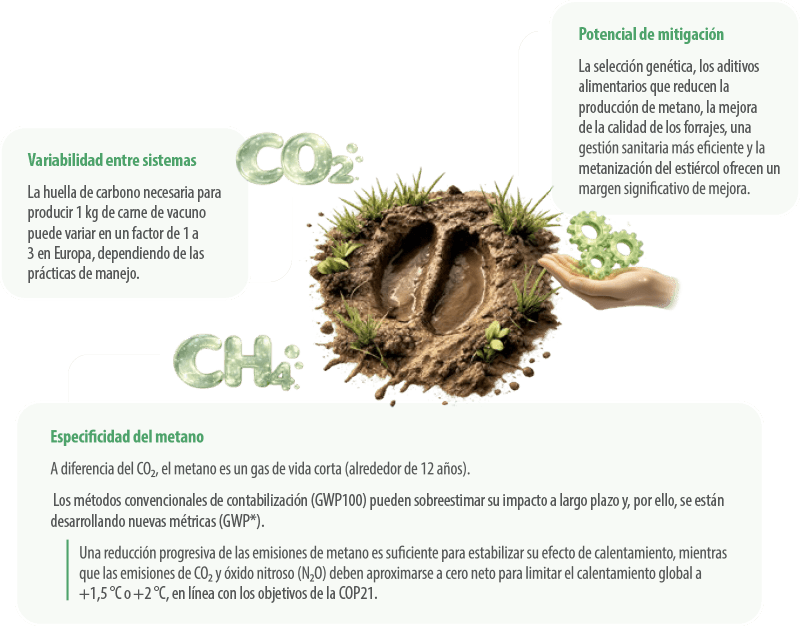
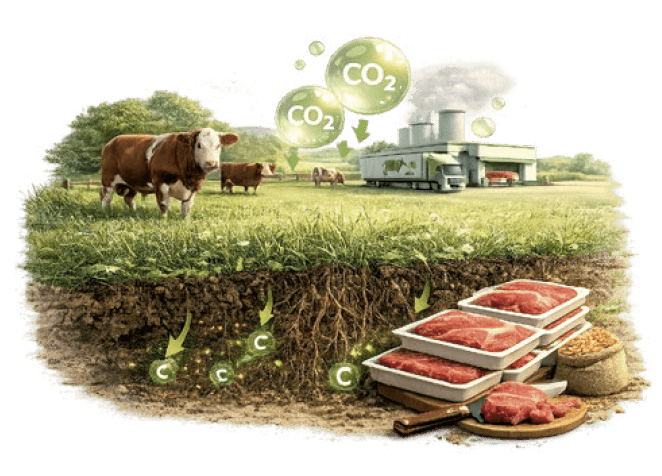
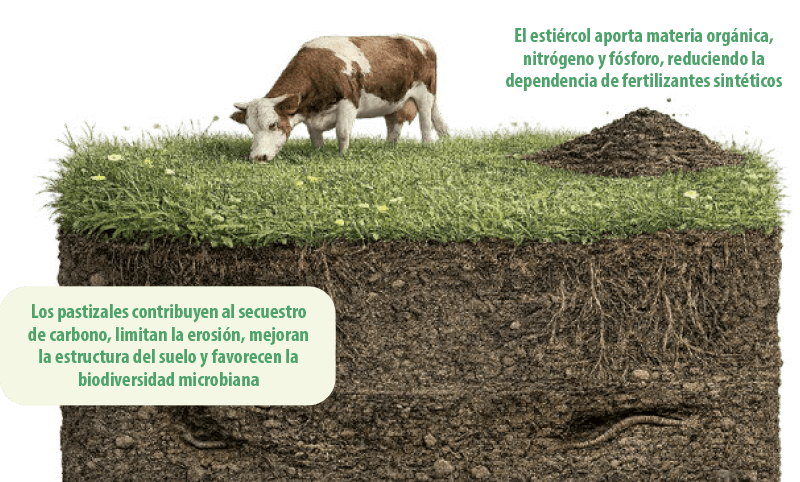
It is important to highlight that grassland-based systems are associated with carbon sequestration in permanent pasture soils. These soils, rich in organic matter, can offset a significant portion of ruminant emissions.
However, this storage effect is insufficiently integrated into standard carbon accounting, leading to an overestimation of the net footprint of pasture-based livestock systems.
PROTEIN EFFICIENCY: AN EXAGGERATED COMPETITION?
It is often claimed that producing 1 kg of animal protein requires an average of 6 kg or more of plant protein, which would suggest a structural biological inefficiency of livestock.
 However, this reasoning is based on a misleading indicator, as it accounts for all plant proteins consumed by animals, including those that are not edible for humans.
Globally, approximately 86% of the proteins consumed by farm animals are not suitable for human consumption, as they come from resources that people cannot ingest: pastures, forage crops, and agricultural by-products (oilseed cakes, brans, distiller’s grains, pulps).
Ruminants, in particular, convert non-cultivable plant resources into food (milk and meat).
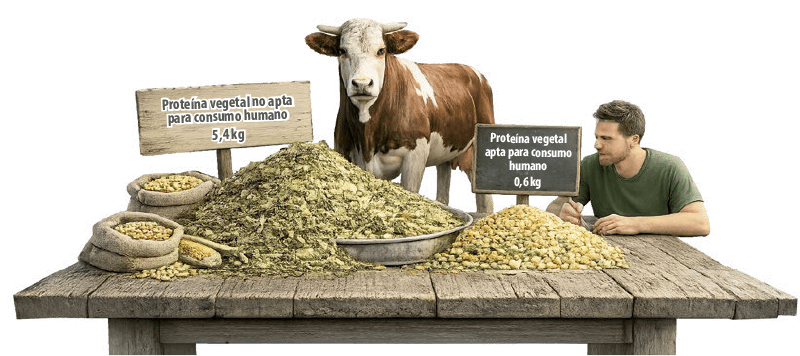
 If only the plant proteins truly edible for humans are considered, ruminants use, on average, 0.6 kg of edible plant protein to produce 1 kg of animal protein (with wide variations depending on the system).
 Consequently, some grassland-based cattle systems can even be net producers of edible protein for humans.
Livestock thus appears not as a mere competitor for human food, but as a converter of inedible biomass into high nutritional value food.
WATER FOOTPRINT: CONFUSION BETWEEN GREEN WATER AND BLUE WATER
The striking figures frequently cited (up to 15,000 L of water/kg of beef) are based on the methodology of the Water Footprint Network, which includes:
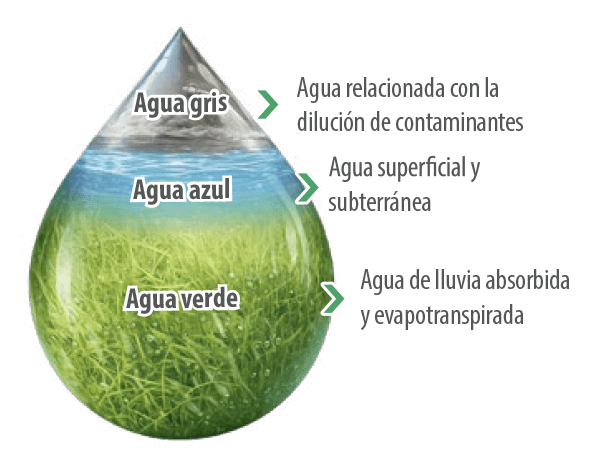
In the case of ruminants, 90–95% of the footprint corresponds to green water (rain on pastures), which would evaporate anyway in the absence of livestock, so considering it “problematic consumption” is questionable.
The central issue concerns blue water whose consumption is estimated at approximately:
510 L/kg for beef
490 L/kg for pork
313 L/kg for chicken
86 L/kg for milk production
In areas with water stress, irrigation of crops for animal feed can compete with other uses. However, in temperate and humid regions, pasture-based livestock systems rely mainly on rainfall and exert limited pressure on water resources. |

UNDERESTIMATED ECOSYSTEM SERVICES OF LIVESTOCK
While the negative impacts are widely documented, the services provided by livestock receive much less attention. Among them are:
 The valorization of marginal lands
The maintenance of soil fertility
The development of circular agriculture
Socioeconomic and cultural contributions
Globally, of the 5 billion hectares of agricultural land, 3.5 billion are grasslands and a considerable portion (1.3 billion hectares) is not suitable for cultivation.
 Ruminants allow the production of meat and milk on these surfaces without competing with crops intended for human consumption.
Eliminating livestock farming would mean abandoning these areas or converting arable land, with the consequent risk of biodiversity loss and emissions associated with land-use change.
Soils under permanent pastures store more carbon than cultivated soils, and their conversion into cropland would release significant amounts of CO2.
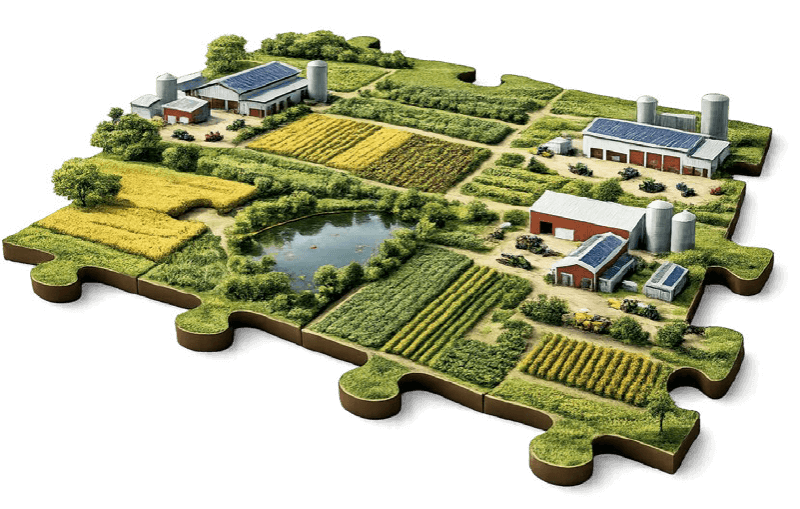
Extreme territorial specialization (intensive livestock areas separated from cereal-growing areas) has broken the natural nutrient cycles, but reintegrating crops and livestock would allow:
 Recycle by-products as animal feed
Introduce nitrogen-fixing legumes
Diversify rotations
Reduce soybean imports
The integrated crop-livestock systems are, therefore, a promising way to enhance protein self-sufficiency, reduce emissions, and restore biogeochemical cycles. |
THE UNDENIABLE SOCIOECONOMIC AND CULTURAL ROLE OF LIVESTOCK
Livestock provides sustenance to 1.3 billion people worldwide and supports approximately 1 billion poor people in developing countries.
It represents up to 40% of agricultural GDP in parts of Africa and South Asia, but also in Europe.
Beyond the economic aspect, meat occupies a central place in culinary traditions, rituals, and cultural heritage, as since domestication in the Neolithic, the relationship between humans and animals has shaped social organization and collective identities.
The benefits and impacts of livestock farming cannot be summarized in a single indicator, but rather a “service package” approach is required to simultaneously evaluate:
|
This approach highlights the need to find a balance between benefits and drawbacks. For example:
|
|
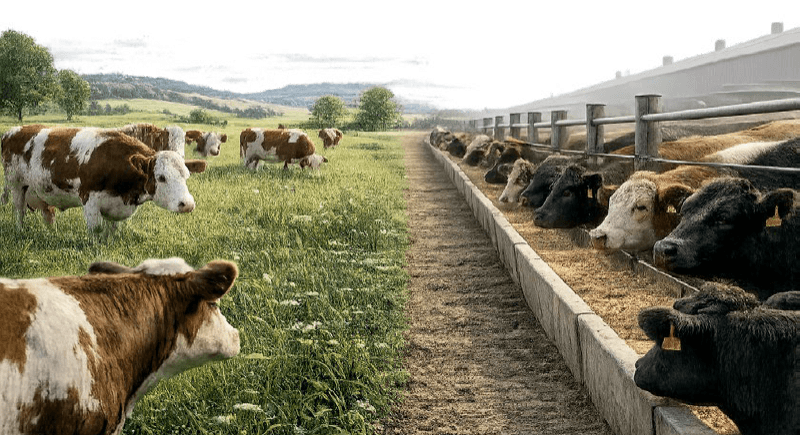
No model is perfect and the challenge is to better manage that balance instead of caricaturing the opposition between intensive and extensive systems.
MEAT SUBSTITUTES: SOLUTION OR ILLUSION?
Plant-based alternatives may present a lower environmental footprint than beef, but debates persist about their nutritional value and degree of processing.
The most disruptive option is meat cultivated from animal cells in bioreactors.
Although it is presented as a solution to climate and ethical issues, significant uncertainties remain:
 Controversial environmental assessments
Potentially high energy demand
Dependence on complex culture media
Unresolved health, nutritional, and sensory issues
Ongoing regulatory debates
Social acceptance remains limited and consumers show curiosity, but little willingness to permanently replace conventional meat.
 Price, perception of naturalness, and taste are significant barriers.
Even if these alternatives were to expand, they would not replace the ecosystem services provided by livestock farming.

CONCLUSION: EVOLUTION RATHER THAN ELIMINATION
This analysis invites us to overcome reductionist views that present livestock farming solely as a climatic, ethical, or environmental problem.
 The key is not to eliminate the activity, but to continue evolving production systems to make them increasingly efficient, integrated, and sustainable.
The true ecological inconsistency lies in the artificial separation between agriculture and livestock farming, being crucial:
 Reintegrate both components
Strengthen grassland-based systems
Better valorize by-products
Improve productive efficiency while respecting the environment and animal welfare
Reduce food waste
A world without livestock for meat production would be difficult to sustain from an agronomic, ecological, economic, and cultural perspective. The goal, therefore, is not to eliminate livestock farming, but to transform it so that it fully contributes to sustainable and resilient food systems. |
Continue reading this content
Register for free or log in to access all rumiNews content.