



Veterinary medicines are fundamental tools for the prevention and treatment of diseases affecting animals, being essential to ensure animal health and welfare, as well as the safety of the food chain.
Among all of them, antimicrobials play a particularly relevant role, as they allow the control of infections caused by bacteria, viruses, fungi, and protozoa. However, their use carries an added responsibility, given their potential contribution to the emergence of resistance.
Antimicrobial resistance (AMR) is considered one of the main threats to global health. Its emergence is closely related to the excessive or inappropriate use of these medicines, both in humans and animals. |
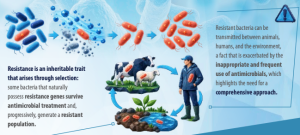
This reality has driven the development of specific legislation aimed at promoting the responsible use of veterinary medicines and combating antimicrobial resistance.
 In the European Union, the Regulation (EU) 2019/6 establishes a harmonized framework for the use of these medicines, with a special emphasis on combating this issue.
 At the national level, the Royal Decree 666/2023 regulates aspects related to the prescription, dispensing, and use of veterinary medicines. In particular, it establishes that:
 Medicines subject to veterinary prescription require a prescription, issued after a prior clinical evaluation of the animals.
The use of antimicrobials must comply with the principles and restrictions established in Regulation (EU) 2019/6, in order to promote a prudent and responsible use of these medicines and contribute to the fight against antimicrobial resistance.
PRUDENT USE OF ANTIMICROBIALS
The concept of prudent use of antimicrobials takes on central importance, framed within the “One Health” approach, which recognizes the interconnection between human health, animal health, and the environment.
In order to maximize their effectiveness and minimize the emergence of resistance, prudent use involves the administration of antimicrobials:
 Only when necessary.
Following scientific criteria.
Under appropriate conditions.

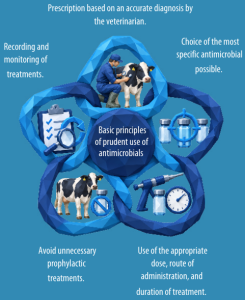
Prudent use involves the adoption of preventive measures for infectious diseases, recognized as one of the most effective strategies to reduce the need for antimicrobial treatments.
These measures range from biosecurity measures to vaccination programs and improved animal management.
 The biosecurity measures limit the entry and spread of pathogens on farms. Among these measures are:
The control of animal and human movements.
Cleaning and disinfection of facilities.
Proper waste management.
Vector control.
 Vaccination programs help to reduce the incidence of numerous infectious diseases, decreasing both the number of necessary treatments and the risk of resistance development.
 Improvement of management and animal welfare also plays a fundamental role.
 Factors such as a balanced diet, adequate density, good environmental conditions, and stress reduction enhance the immune response capacity of the animals and decrease their susceptibility to infections.
The prudent use of antimicrobials requires the commitment of all stakeholders involved in animal production.
 The continuous training of veterinarians is essential for making appropriate decisions aligned with the latest scientific recommendations. Similarly, the awareness of farmers and owners is crucial to promote responsible practices and ensure the correct application of prescribed treatments.

IMPORTANCE OF DIAGNOSIS IN THE USE OF ANTIMICROBIALS
Linked to the concept of prudent use, accurate diagnosis is the fundamental pillar for the rational use of antimicrobials in veterinary medicine.
 The initiation of antimicrobial treatment without proper identification of the pathological process and the responsible microorganism(s) increases the risk of therapeutic failure and promotes the development of resistance.
In this context, international guidelines recommend that the administration of antimicrobials should only be carried out after an adequate clinical evaluation and an accurate diagnosis by the veterinarian.
This diagnosis must be confirmed, whenever possible, with laboratory tests that allow isolation and identification of the etiological agent. Additionally, an antimicrobial susceptibility test should be conducted, based on validated interpretation criteria (for example, the use of clinical cut-off points or breakpoints) to establish an appropriate treatment.
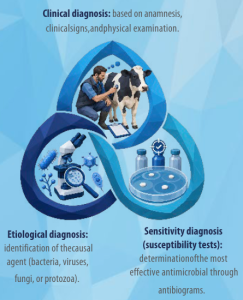
This methodology, considered the most appropriate, is not always feasible, such as in cases of:
 Very acute or severe diseases.
Difficulty in sampling at the site of infection.
Inability to perform a routine method of isolation or culture of the microorganism.
Lack of methods for sensitivity evaluation or clinical cut-off points.
In these cases, the empirical use of antimicrobials may be justified, with the diagnosis subsequently confirmed through appropriate tests.
Empirical treatment should be based on the available local epidemiological information on the sensitivity of target bacteria.
This approach reduces the unnecessary use of broad-spectrum antimicrobials and optimizes therapeutic efficacy.
Clinical Diagnosis 
Clinical diagnosis is the first step in establishing an appropriate treatment, ensuring a prudent and responsible use of antimicrobials. It is based on:
The anamnesis.
The evaluation of epidemiological history.
The observation of clinical signs.
Conducting a complete physical examination of the affected animals.
This approach allows for establishing an initial diagnostic suspicion, assessing the severity of the process and guiding the treatment, although in many cases it is not sufficient to precisely identify the responsible microorganism. |
Etiological Diagnosis 
In addition to the clinical assessment of the patient, an adequate diagnosis includes the isolation and identification of the etiological agent at the genus and species level.
This allows for selecting the most appropriate complementary tests and guiding the treatment specifically.
For a correct etiological diagnosis, a proper sample collection is essential, which must be representative of the pathology and of sufficient quality, based on a thorough knowledge of the epidemiology and pathogenesis of the disease.
The harmonization of laboratory procedures and the use of standardized microbiological techniques and methods used for the isolation and identification of bacteria are fundamental to ensure the comparability of results between different laboratories, regions, and farms. Additionally, they serve as a basis for conducting antimicrobial sensitivity tests. |
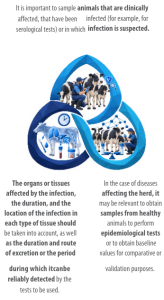
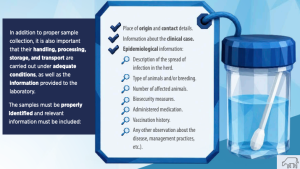
Etiological diagnostic tests will be carried out in laboratories that comply with established quality management standards, selecting the most appropriate test for each case ensuring that it is correctly validated based on a series of criteria:
 Variables related to the sample: whether they are individual or grouped, matrix composition, host-organism interactions affecting the analyte, etc.
Variables related to the analytical system: physical, chemical, biological, and technical factors that influence the method’s ability to detect the analyte.
Variables related to the interpretation of the result.
For a diagnostic test to be reliable, it must be accurate and precise, as these parameters define the performance of the test.
The accuracy is represented by the sensitivity and specificity, which are established based on the cutoff point.
The repeatability and reproducibility define the accuracy of the test.
From a diagnostic point of view:
The sensitivity is the ability of the test to detect animals that are truly infected (percentage of true positives). |
The specificity is the ability of the test to detect healthy animals (true negatives). |

Sensitivity Diagnosis 
Once the causal agent is identified, the antimicrobial sensitivity test is the final step, allowing the veterinarian to choose the most appropriate medication to treat the clinical case.
 Additionally, it provides valuable data to evaluate sensitivity trends over time and monitor the emergence and spread of resistance for surveillance purposes.
The standardization and harmonization of the methods used to evaluate sensitivity and interpret the results are essential to generate accurate and reproducible data, thus enabling data comparison between different national or international surveillance or monitoring programs.
Among the available methods, we can mention phenotypic or conventional methods, such as:
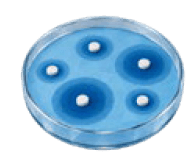 Disk diffusion.
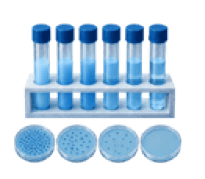 Dilution in broth and agar.
 Gradient strips.
 The broth microdilution for the determination of the minimum inhibitory concentration (MIC) is the reference method approved by the CLSI (Clinical and Laboratory Standards Institute) and the EUCAST (European Committee on Antimicrobial Susceptibility Testing) for its high reproducibility and comparability. The validation and standardization of this method includes parameters such as:
The media used.
The inoculum density.
The time and incubation conditions.
The quality controls.
The choice of antimicrobial agents.
The subsequent interpretative criteria.
The methodology used, including the specifications and interpretative criteria, are clearly defined and documented, so that they can be used by all laboratories where these tests are carried out.
In this regard, there are national or regional reference laboratories that work in cooperation with standardization organizations (such as CLSI or EUCAST) to coordinate methodologies, interpretations, and techniques used to ensure accuracy and reproducibility.
In the context of sensitivity diagnosis, molecular techniques, such as PCR and genomic sequencing, have also gained increasing importance in the rapid detection of resistance genes, although they are currently still considered complementary to conventional phenotypic methods.

The main objective of antimicrobial sensitivity tests is to predict how a bacterial pathogen may respond to an antimicrobial agent in vivo. |
The results are described by qualifying the isolate as susceptible (S), intermediate (I), or resistant (R) to the antimicrobial, or as a wildtype (WT) or non-wildtype (NWT) strain, applying clinical (breakpoints) or epidemiological (ECOFF: Epidemiological Cut-Off) cut-off points for this purpose.
These cut-off points are established by standardization organizations, scientific professional societies, or regulatory bodies, based on a series of data, such as the MIC distribution of microorganisms, the pharmacokinetic and pharmacodynamic parameters of the antimicrobial, and the results of clinical trials or animal treatment.

The responsible use of antimicrobials in veterinary medicine should be based on an accurate diagnosis, grounded in the clinical assessment of the patient and, whenever possible, in the identification of the etiological agent through standardized microbiological methods.
The correct sampling, isolation, and identification of the causative microorganism and obtaining reliable data on its sensitivity are fundamental tools to support therapeutic decision-making.
In this way, a prescription based on clinical and microbiological criteria not only ensures a greater efficacy of the treatment and the recovery of the animal, but also contributes to minimizing the emergence and spread of antimicrobial resistance.
THE ROLE OF THE VETERINARIAN IS FUNDAMENTAL
Veterinarians play a fundamental role in the fight against antimicrobial resistance, as they are responsible for ensuring the rational and prudent use of these drugs.
Therapeutic decision-making should be based on clinical, epidemiological, and health criteria, taking into account both the characteristics of the animal or group of animals and the risk factors associated with the emergence and spread of resistance.

In the context of antimicrobials, these medications are always subject to veterinary prescription, which must be carried out only after a clinical evaluation that allows for the suspicion of a bacterial infection or in accordance with health programs and previously established therapeutic protocols. |
The European Medicines Agency (EMA), through the Antimicrobial Expert Group (AMEG), has developed a system of categorization of veterinary antibiotics based on their importance to public health and the risk their use poses regarding the emergence of resistance.
This classification establishes specific recommendations to promote more prudent use of antimicrobials and preserve the efficacy of those considered critically important for human medicine.
The categorization distinguishes 4 different categories of antibiotics.
A. Avoid: antibiotics that are not authorized in veterinary medicine in the EU. These drugs cannot be used in animals intended for food production and can only be administered to companion animals in exceptional circumstances. |
B. Restricted use: antibiotics whose use should be restricted with the aim of mitigating the risk to human health. |
C. Use with caution: antibiotics that should only be used when there are no effective options in category D. |
D. Use prudently: antibiotics that can be used prudently, avoiding unnecessary use, in long and/or group treatments. |
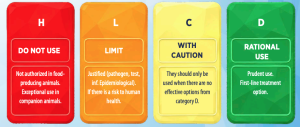
Figure 1. Use of antibiotics according to category (EMA) (Annex I RD 666/2023).
 The PRAN has developed the application “Therapeutic Guide for Veterinary Antimicrobials” as a tool to support veterinary clinical practice, providing standardized information for the prescription of antibiotic treatments.
The application offers recommendations on treatments, antibiotic selection, administration guidelines, and epidemiological situation according to the geographical area for:
Facilitating compliance with current regulations.
Promoting the responsible use of antimicrobials.
Contributing to the homogenization of therapeutic criteria at the national level.
CONCLUSIONS
Antimicrobial resistance is one of the main challenges for global health and requires coordinated action from all sectors involved under the One Health approach.
In this context, the veterinarian plays an essential role in promoting the prudent and responsible use of antimicrobials, based on a precise diagnosis and a prescription based on scientific and clinical criteria.
Likewise, the implementation of responsible use programs, along with the application of effective preventive measures and the continuous training of professionals and other involved agents, is essential to reduce the emergence and spread of resistance.
The integration of these strategies constitutes the most effective tool to preserve the therapeutic efficacy of antimicrobials, protect animal and public health, and ensure the availability of these medications for future generations. |
BIBLIOGRAPHY
1. World Organisation for Animal Health (OMSA/WOAH). Responsible and prudent use of antimicrobials in veterinary medicine [woah.org]
2. OMSA: Manual of Diagnostic Tests and Vaccines for Terrestrial Animals. https://www.woah.org/en/what-we-do/standards/codes-and-manuals/
3. WHO (2017). Guidelines on the use of antimicrobials in animals [iris.who.int]
4. WOAH. Global strategy against antimicrobial resistance [woah.org]
5. Regulation (EU) 2019/6 on veterinary medicinal products [eur-lex.europa.eu]
6. Royal Decree 666/2023, regulating the distribution, prescription, dispensing, and use of veterinary medicinal products.
7. One Health – Antimicrobial Resistance Learning Site [amrls.umn.edu]
8. FAO/WHO/WOAH. Global action plan against AMR [apps.who.int]
9. Guideline on the summary of product characteristics (SPC) for veterinary medicinal products containing antimicrobial substances – Revision1EMA/CVMP/383441/2005-Rev.1 Corr1EMA/CVMP/383441/2005-Rev.1 Corr1
10. Guideline for the demonstration of efficacy for veterinary medicinal products containing antimicrobial substances – EMA/CVMP/627/2001 Rev.2*
11. Guideline on the summary of product characteristics for antiparasitic veterinary medicinal products – Revision 1 EMA/CVMP/EWP/170208/2005 Rev.1
12. Reflection paper on anthelmintic resistance CVMP/EWP/573536/2013
13. https://www.resistenciaantibioticos.es/es
14. https://eu-jamrai.eu/
15. https://www.ema.europa.eu/en/veterinary-regulatory-overview/antimicrobial resistance-veterinary-medicine/veterinaryantibiotics-dosage-review-adjustment-adra-project
16. https://guiaveterinaria.resistenciaantibioticos.es/
You may be interested in: PCI and PROA in cattle: key elements for its implementation
Continue reading this content
Register for free or log in to access all rumiNews content.