



Antimicrobial resistance (AMR) represents one of the greatest global health challenges.
 In Spain, the cornerstone for addressing this problem is the National Plan against Antibiotic Resistance (PRAN), aligned with the strategies of the Quadripartite (the Food and Agriculture Organization of the United Nations (FAO), the World Organisation for Animal Health (WOAH), the World Health Organization (WHO), and the United Nations Environment Programme (UNEP)) and the European Union (EU) under the “One Health” approach.
The Council Recommendation (2023/C 220/01) encourages Member States to implement measures that improve the health and welfare of food-producing animals in order to reduce the frequency and spread of infectious diseases and, consequently, the need to use antimicrobials. Among these recommendations, the development and implementation of the following stand out:
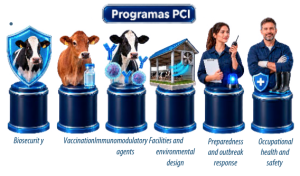
Infection Prevention and Control (IPC) Programs A set of principles, practices, and measures applied at all levels (individual animal, populations, personnel, and infrastructure) aimed at preventing, reducing, and controlling the occurrence of infections. IPC encompasses, among other measures:
|
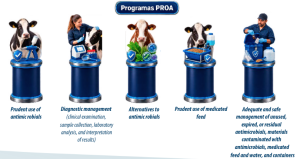
Antimicrobial Stewardship Programs (AMS) A set of strategies and actions aimed at promoting the prudent use of antimicrobials, with the objective of:
Minimizing the emergence and spread of AMR. Preserving the availability of these medications for the future. |
 Maximizing their therapeutic efficacy.
IPC AND AMS PROGRAMS
Addressing AMR requires coordinated actions based on scientific evidence across all sectors, disciplines, and levels of governance.
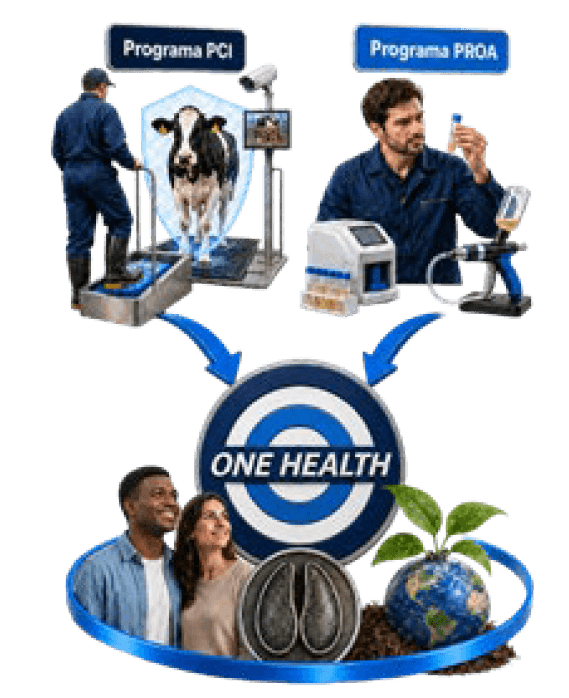 In this context, IPC and AMS programs are fundamental and complementary strategies aimed, respectively, at preventing and controlling infections and optimizing the use of antimicrobials, jointly contributing to the reduction of AMR, the improvement of animal health, and the protection of public health from a One Health perspective.
Despite the existence of plans and recommendations in the EU, the development and implementation of IPC and AMS programs vary considerably among EU Member States.
Following the recommendations made by the first European Joint Action on Antimicrobial Resistance and Healthcare-Associated Infections (EU-JAMRAI, 2017–2021), establishing a set of core elements and harmonized standards for the development and implementation of these programs is considered a priority.
The second EU-JAMRAI (2024–2027) has established as strategic objectives the identification of essential elements, key competencies, and the indicators needed to evaluate the degree of development and implementation of these programs.
These are presented in the form of reference frameworks or guidelines that will provide a minimum common basis for all EU Member States, allowing for their adaptation and implementation based on national and sectoral contexts.
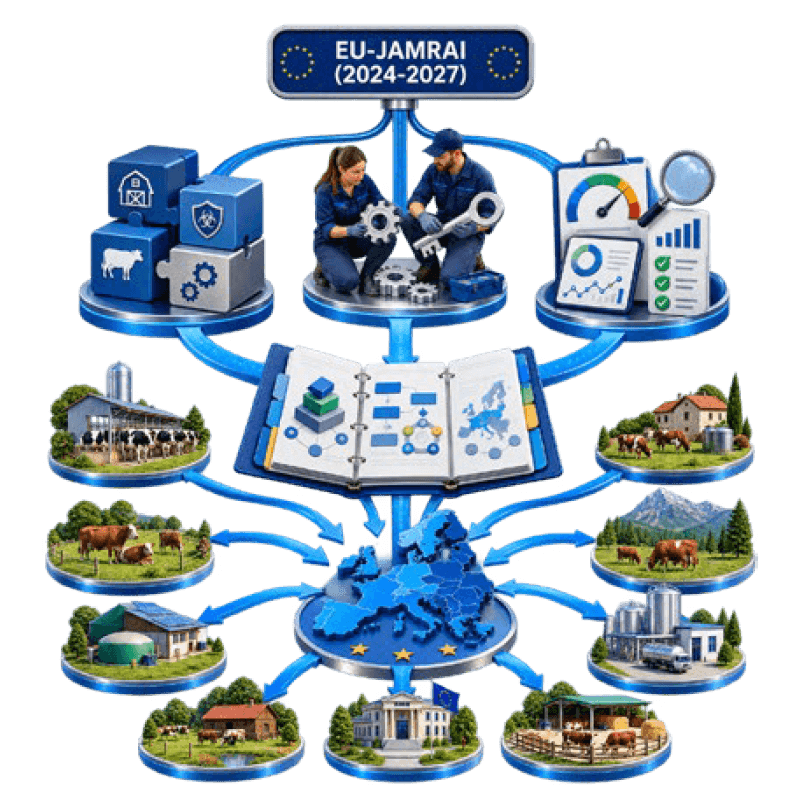
PRAN co-leads the European working groups responsible for drafting these guidelines for IPC and AMS programs, covering both companion animals and food-producing animals. |
Terminology
In line with the objective of EU-JAMRAI2 to strengthen and harmonize actions against AMR following a One Health approach, the effective development and implementation of IPC and AMS programs depend on a common and precise understanding of key terminology.
The inconsistent or ambiguous use of terms can:
 Hinder communication.
Limit comparability.
Reduce the impact of AMR-related interventions.
Essential Elements
An essential element is a fundamental structural or operational component of an action framework, crucial for ensuring its effective design, implementation, and sustainability.
 Essential elements represent areas of action or capacities that must be addressed to ensure coordinated, consistent, and measurable outcomes.

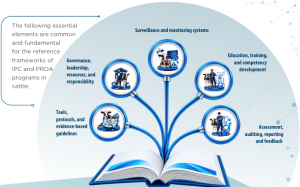
Evidence-based tools, protocols, and guidelines 
They encompass the development, adaptation, dissemination, and regular updating of standardized guidelines (such as treatment guidelines), as well as decision-support protocols and tools aimed at guiding IPC and AMS interventions in cattle farms.
These tools, protocols, and guidelines must:
 Be based on the best available scientific evidence.
Be aligned with international standards.
Be adapted to local epidemiology, the species of interest (in this case, cattle), production systems, and existing resources.
For example, treatment protocols, clinical guidelines (standards/handbooks), hygiene procedures, biosecurity checklists, and decision-support materials that are accessible and available for routine use are routinely found on a farm or within veterinary services. |
Governance, leadership, resources, and accountability
They refer to the establishment of formal structures, policies, and mechanisms to ensure that IPC and AMS programs are prioritized, coordinated, adequately resourced, and effectively implemented in the cattle sector. This includes:
Clear assignment of roles and responsibilities.
Leadership commitment.
The existence of regulatory frameworks.
Sustainable financing.
Adequate infrastructure.
Mechanisms for coordination, supervision, capacity building, and accountability.
For example, on a farm, a veterinary professional is designated as responsible for IPC and AMS interventions. |
Surveillance and monitoring systems 
They refer to the systematic collection, analysis, interpretation, and use of data on infectious diseases in animals, antimicrobial use, and AMR, including animal and zoonotic pathogens.
Surveillance systems must:
Support risk assessment.
Guide IPC and AMS interventions.
Enable the early detection of emerging threats.
Facilitate the evaluation of the implementation of IPC and AMS programs on farms.
For example, on the cattle farm, monitoring systems are in place to detect infectious diseases and AMR, as well as an antimicrobial use log, linked to integrated national surveillance systems. |
Education, training, and competency development 
They refer to undergraduate and postgraduate training, as well as continuing education for veterinarians, animal health professionals and paraprofessionals, and other relevant stakeholders, in order to ensure the knowledge, skills, attitudes, and behaviors necessary for the effective implementation of IPC and AMS programs.
Training programs must:
Be competency-based.
Be context-specific.
Be supported by continuing professional development and behavioral change strategies.
For example, all personnel associated with a livestock farm (owner, workers, veterinarians) must be aware of the AMR problem and understand the importance of the prudent use of antimicrobials. Likewise, they must be aware of the relevance of disease prevention and control strategies. |
Evaluation, audit, reporting, and feedback 
They refer to the systematic assessment of the implementation of IPC and AMS programs through the use of indicators, audits, and other evaluation methods, ensuring timely reporting and feedback to stakeholders.
These processes must:
Support continuous quality improvement.
Inform decision-making.
Strengthen accountability.
Guide the optimization of IPC and AMS program interventions.
For example, the evaluation of IPC and AMS programs is integrated into the existing livestock health planning or facility quality management systems, thus ensuring regular monitoring and the application of improvement measures. |
Technical pillars
Technical pillars refer to the specific interventions, measures, and practices required to carry out IPC and AMS programs in animal health.
Although AMS and IPC share common essential elements that facilitate them, the technical pillars are distinct and address different objectives and technical practices.
CONCLUSION
AMR constitutes a growing challenge that demands a coordinated, sustained, and evidence-based response under the One Health approach.
In this context, IPC and AMS programs represent essential and complementary tools to protect animal health, preserve the efficacy of antimicrobials, and contribute to global public health and food security.
The definition of a common framework of terminology, essential elements, key competencies, and indicators at the European level, driven by EU-JAMRAI2 and co-led by PRAN, represents a fundamental step toward the harmonization of strategies across EU Member States.
In Spain, PRAN contributes to this process by promoting the development and implementation of AMS programs in animal health and advancing infection prevention and control measures, monitoring of antimicrobial consumption and AMR, in collaboration with the involved sectors and relevant stakeholders.
You may be interested in: Correct diagnosis and prudent use of antimicrobials
Continue reading this content
Register for free or log in to access all rumiNews content.